Investment Markets Review 2025: Key Events & Themes that Shaped the Year
January 2026
Back to InsightsSubscribe

Investment Markets Review 2025: Key Events & Themes that Shaped the Year

Savana

1 January 2026

Investment Markets Review 2025: Key Events & Themes that Shaped the Year

From a distance, 2025 may be observed as another strong year for investors, with global equity markets extending their post-pandemic run of gains. But the final results mask a year shaped by heightened uncertainty, abrupt market moves and a series of competing economic and geopolitical pressures that made the investment landscape anything but straightforward.

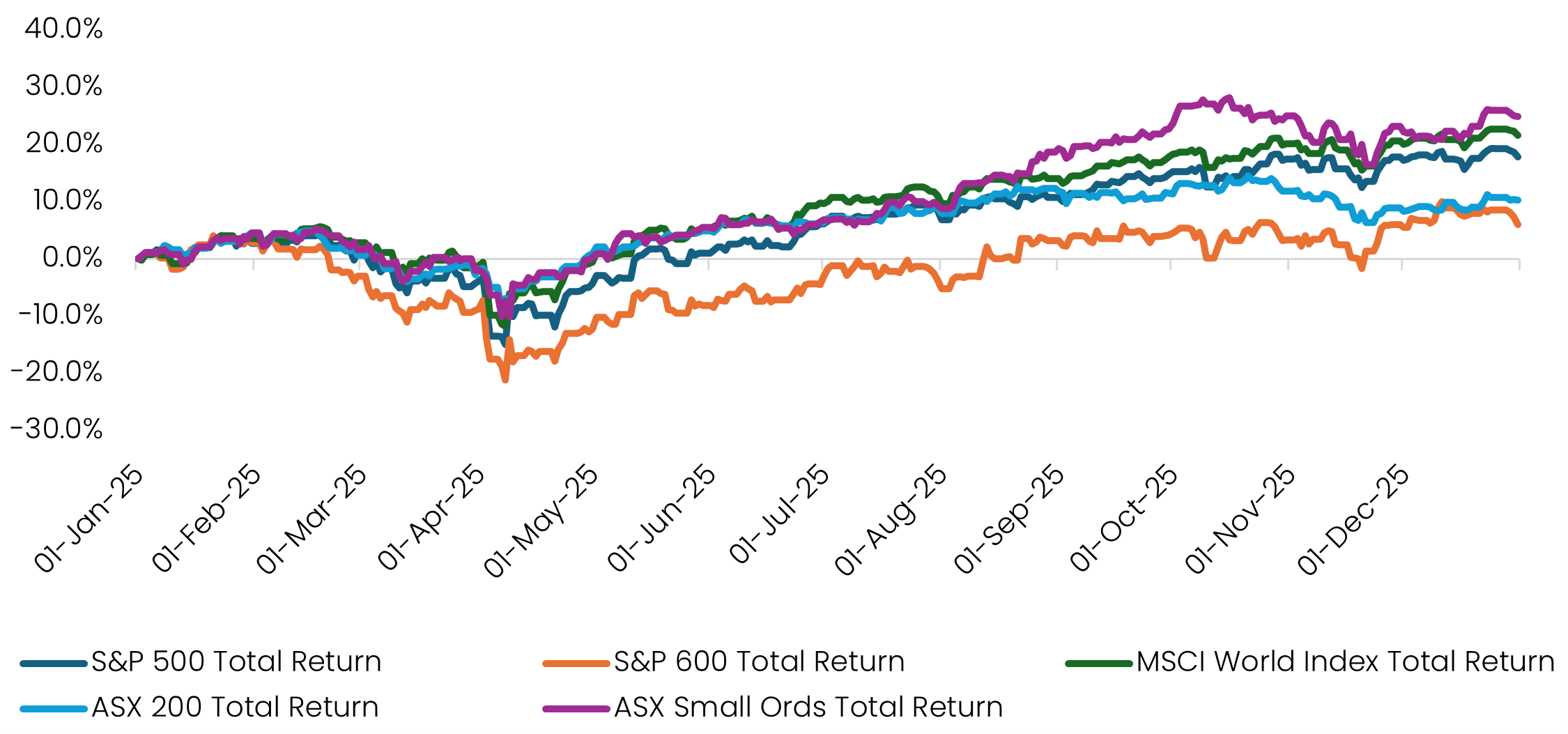
Major Indicies – CY25 Total Returns
Source: S&P Global, Savana.

The year opened cautiously, as investors assessed the implications of a second Trump term in office. That caution turned swiftly to alarm in the second quarter, when the President’s tariff push triggered the sharpest market sell-off since the pandemic. The S&P 500 fell roughly 16% peak-to-trough, as fears around inflation, supply-chain disruption and global growth rapidly took hold.

With hindsight, the sell-off proved an overreaction. Markets once again underestimated Trump’s familiar playbook of brinkmanship and pragmatism. Initial “Liberation Day” posturing was soon followed by negotiated outcomes, including revised arrangements with the UK, Europe and Japan, alongside a tentative easing in tensions with China.

US Average Tariff Rate
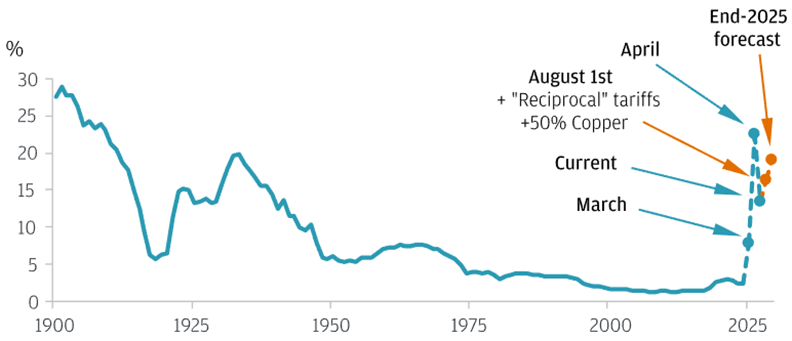
Source: JP Morgan. 2025. “US Tariffs: What’s the Impact on Global Trade and the Economy?” December 5, 2025.

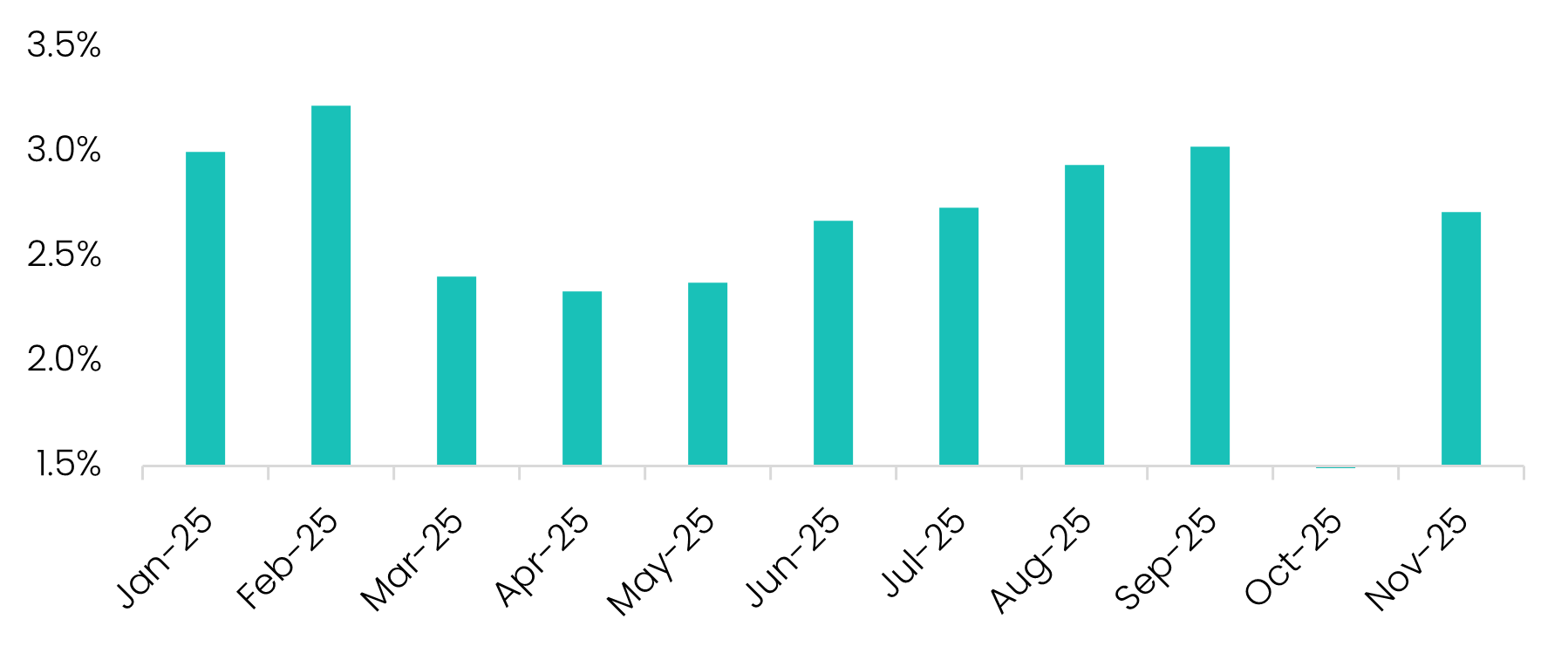
More importantly, the economic damage many feared failed to materialise. US inflation remained broadly contained - hovering in the 2.5–3.0% range, and sitting around 2.7% at the last count. Companies absorbed more of the tariff burden than expected, supply chains adjusted, and ongoing technology-driven productivity gains helped offset cost pressures.

US Inflation Rate
Source: S&P Global, Savana.

For Savana, the episode reinforced three long-held principles: the importance of staying invested through periods of stress, the risks inherent in trying to trade around short-term macro noise, and the enduring robustness of the US economy despite adversity.

By mid-year, markets began to stabilise. The second half of 2025 saw a welcomed V-shaped recovery, as ever-plucky investors managed to shrug off lingering concerns around runaway fiscal deficits, geopolitical tensions and elevated valuations.

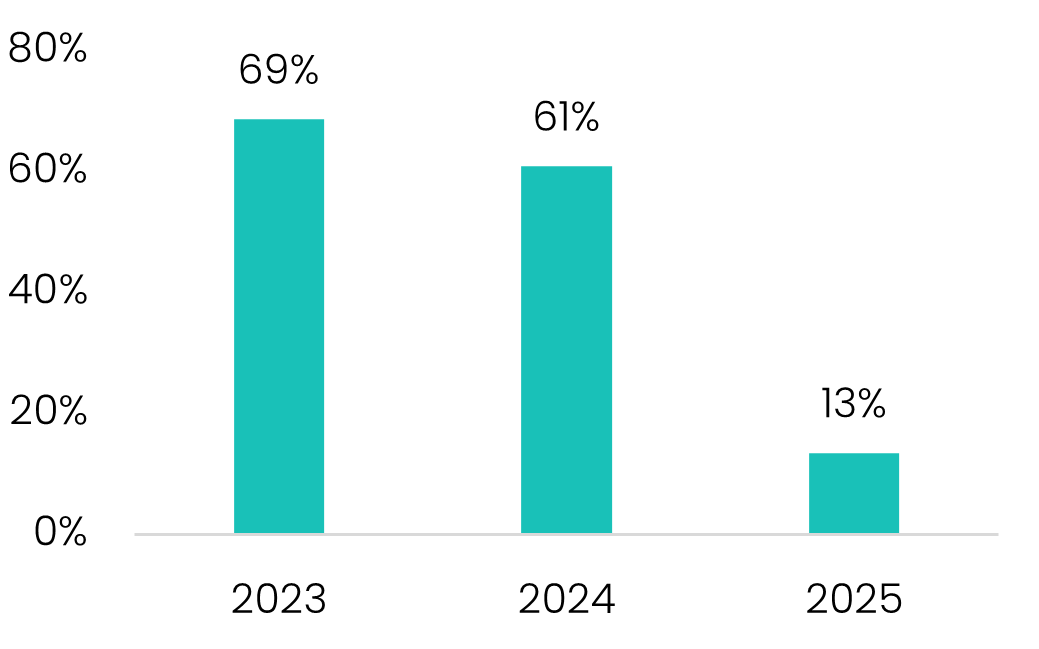
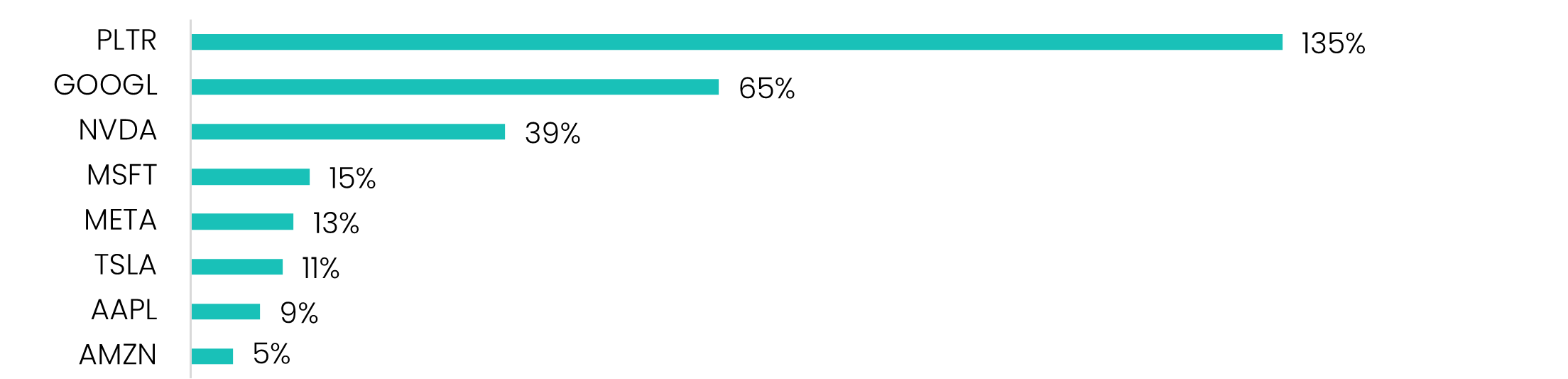
Optimism remained firmly anchored in Big Tech and the AI narrative. Despite slowing earnings growth and persistently stretched valuations, the Magnificent Seven – representing a third of the S&P 500 - collectively climbed a further 23%, led by standout gains in Nvidia (+39%) and Alphabet (+66%).

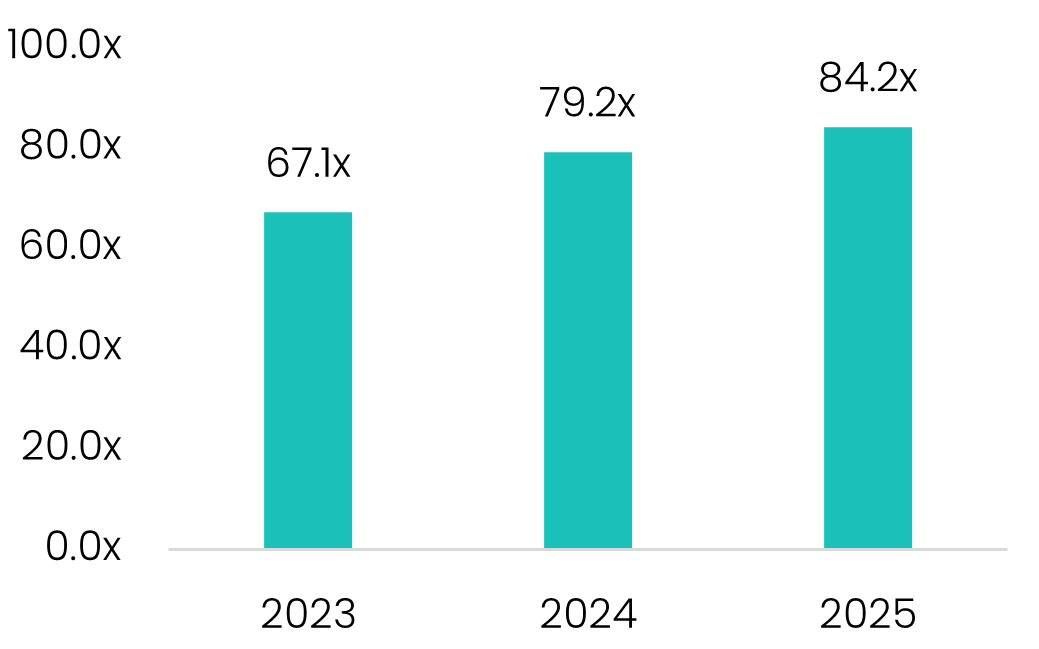
Yet the year’s biggest equity winner was big-data specialist Palantir, which surged 135% on the back of rapid revenue growth and its perceived leadership in applied AI. That rally, however, left Palantir with a less flattering distinction: one of the most expensive stocks in the S&P 500, with investors paying roughly $399 for every dollar of current earnings.

Ave. Mag-7 Earnings Growth
Ave. Mag-7 PE Ratios
Mag-7 + Palantir Share Price Performance
Source: S&P Global, Savana.

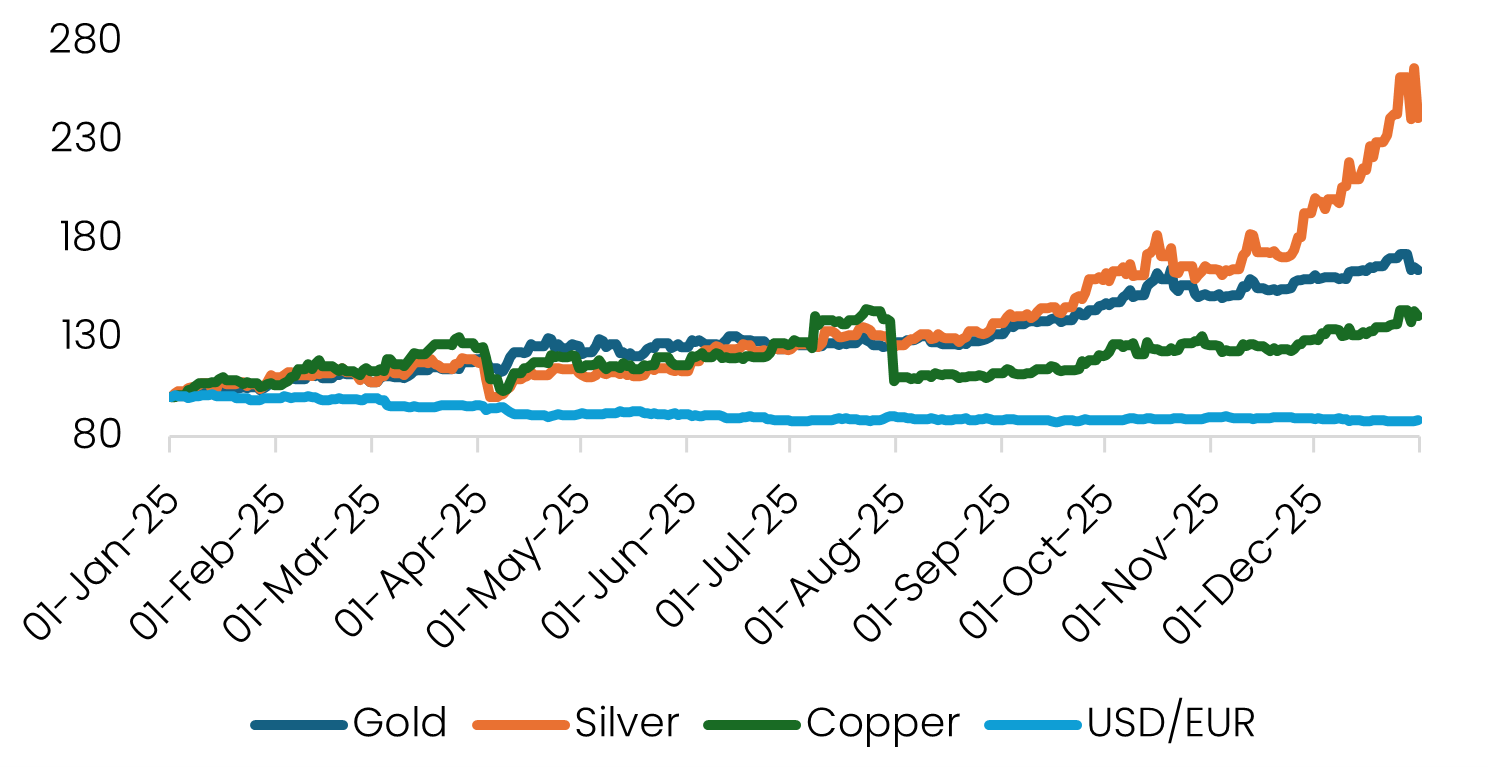
Away from equities, another defining feature of the year was the strong performance of commodities - particularly gold (+64%), silver (+141%) and copper (+41%). Silver and copper benefited from expanding industrial demand linked to renewable infrastructure, semiconductor equipment and defence.

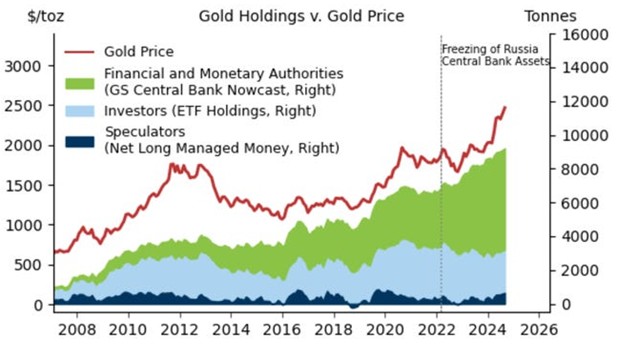
Gold’s continued ascent, meanwhile, was widely viewed as a flight to safety amid inflation concerns, geopolitical conflict and market volatility. It also reflected a quieter structural shift underway. Central banks globally - most notably in China and Russia - continued to reduce their reliance on US dollar reserves by increasing allocations to gold.

This formed part of a broader shift away from US assets over the course of the year, driven by rising protectionism, fading enthusiasm for US exceptionalism and widening interest-rate differentials. The result was a notably weaker US dollar, down around 10% over the year.

Central Bank Gold Purchases
Source: Goldman Sachs (via Business Insider, “3 reasons why surging gold prices will climb another 8% by the end of 2025, Goldman says”, November 1, 2024).

Price Performance: Gold, Siver, Copper, EUR/USD (rebased)
Source: S&P Global, Savana.

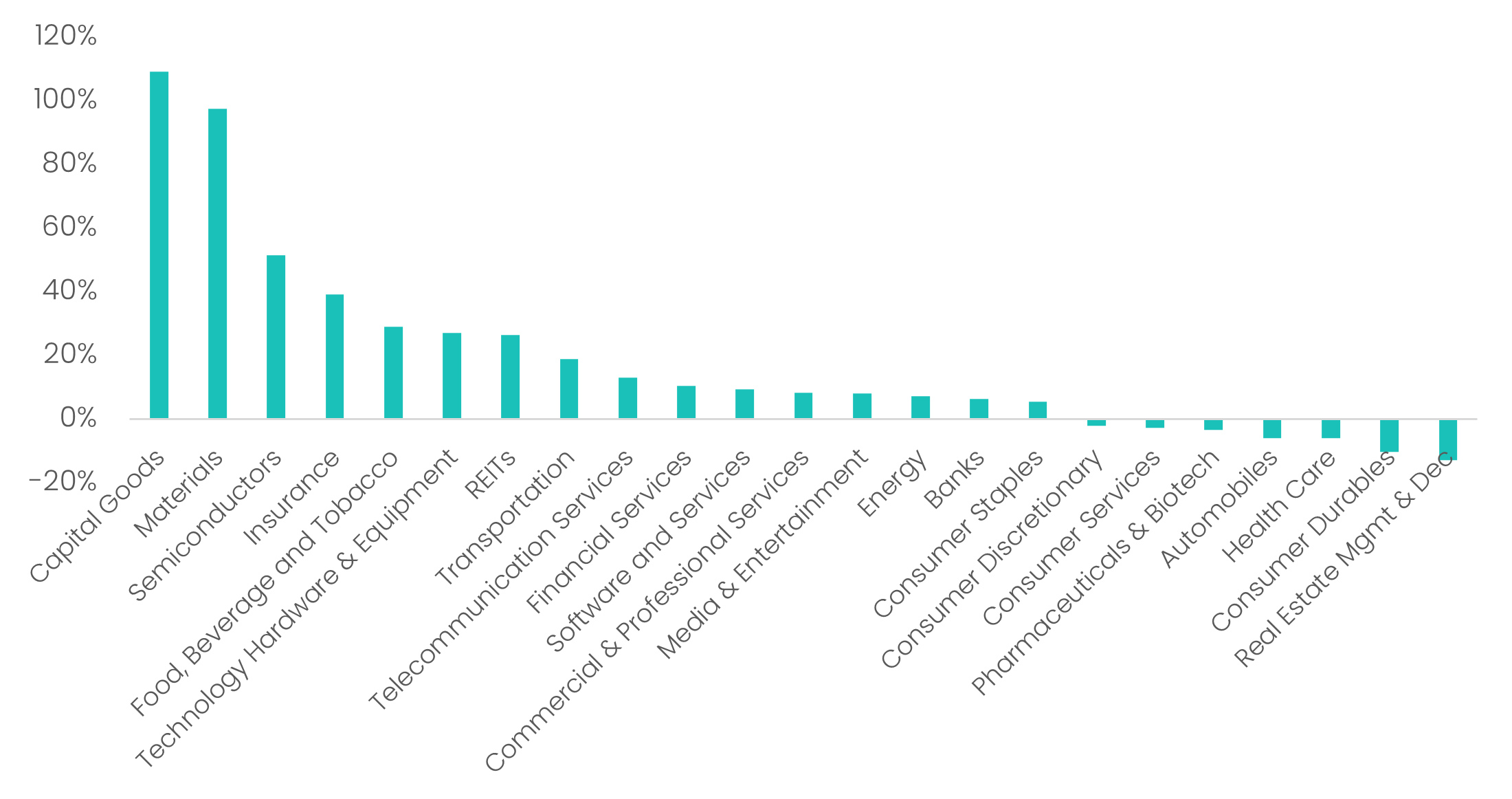
Closer to home, Australian equity markets also delivered a solid outcome. Of particular note was the renewed strength in the ASX Small Ordinaries Index (+25.0%), which outperformed the ASX 200 for only the second time in eight years.

While some attributed this to rotation away from large-cap defensives, the underlying driver was earnings growth of 34%. The result was powered by a high win rate (67%) and meaningful upside dispersion, with 25 of the 194 companies in the index delivering returns in excess of 100%.

Of those standout performers, 18 were specialist gold or diversified metals companies, while several Aerospace & Defence names also featured prominently - including Electro Optic Systems (+686%), DroneShield (+334%) and Austal (+133%).

ASX Small Ords Index – Average Return by Industry Group
Source: S&P Global, Savana.

Markets are never straightforward, but 2025 presented a particularly complex mix of extraordinary and often competing forces:

• Elevated valuations were traded-off against the transformative growth potential of AI.

• Large fiscal deficits helped keep economies moving, but at the cost of upward pressure on inflation and an ever-growing debt burden.

• Monetary policy was caught between competing demands on both sides of the dual mandate.

• Long-held notions of US exceptionalism were challenged by an unconventional and increasingly interventionist administration.

• And geopolitics continued to play a more prominent role, with US–Europe decoupling and a renewed push for national self-sufficiency supporting a shift in capital towards local markets.

For all its complexity, 2025 reinforced a familiar truth: clear strategy and disciplined execution tend to reward long-term investors. Savana’s systematic approach reflects this philosophy, grounded in the belief that attractively valued companies with strong fundamentals will deliver superior outcomes over time.

As for 2026, our only prediction is that elevated uncertainty and volatility are here to stay.

Good luck to all investors.

Link to Original ArticleBack to Insights
Letter to Investors
January 2026
| © Savana Asset Management Pty Ltd

From a distance, 2025 may be observed as another strong year for investors, with global equity markets extending their post-pandemic run of gains. But the final results mask a year shaped by heightened uncertainty, abrupt market moves and a series of competing economic and geopolitical pressures that made the investment landscape anything but straightforward.

Major Indicies – CY25 Total Returns

Source: S&P Global, Savana.

The year opened cautiously, as investors assessed the implications of a second Trump term in office. That caution turned swiftly to alarm in the second quarter, when the President’s tariff push triggered the sharpest market sell-off since the pandemic. The S&P 500 fell roughly 16% peak-to-trough, as fears around inflation, supply-chain disruption and global growth rapidly took hold.

With hindsight, the sell-off proved an overreaction. Markets once again underestimated Trump’s familiar playbook of brinkmanship and pragmatism. Initial “Liberation Day” posturing was soon followed by negotiated outcomes, including revised arrangements with the UK, Europe and Japan, alongside a tentative easing in tensions with China.

US Average Tariff Rate

Source: JP Morgan. 2025. “US Tariffs: What’s the Impact on Global Trade and the Economy?” December 5, 2025.

More importantly, the economic damage many feared failed to materialise. US inflation remained broadly contained - hovering in the 2.5–3.0% range, and sitting around 2.7% at the last count. Companies absorbed more of the tariff burden than expected, supply chains adjusted, and ongoing technology-driven productivity gains helped offset cost pressures.

US Inflation Rate

Source: S&P Global, Savana.

For Savana, the episode reinforced three long-held principles: the importance of staying invested through periods of stress, the risks inherent in trying to trade around short-term macro noise, and the enduring robustness of the US economy despite adversity.

By mid-year, markets began to stabilise. The second half of 2025 saw a welcomed V-shaped recovery, as ever-plucky investors managed to shrug off lingering concerns around runaway fiscal deficits, geopolitical tensions and elevated valuations.

Optimism remained firmly anchored in Big Tech and the AI narrative. Despite slowing earnings growth and persistently stretched valuations, the Magnificent Seven – representing a third of the S&P 500 - collectively climbed a further 23%, led by standout gains in Nvidia (+39%) and Alphabet (+66%).

Yet the year’s biggest equity winner was big-data specialist Palantir, which surged 135% on the back of rapid revenue growth and its perceived leadership in applied AI. That rally, however, left Palantir with a less flattering distinction: one of the most expensive stocks in the S&P 500, with investors paying roughly $399 for every dollar of current earnings.

Ave. Mag-7 Earnings Growth
Ave. Mag-7 PE Ratios
Mag-7 + Palantir Share Price Performance

Source: S&P Global, Savana.

Away from equities, another defining feature of the year was the strong performance of commodities - particularly gold (+64%), silver (+141%) and copper (+41%). Silver and copper benefited from expanding industrial demand linked to renewable infrastructure, semiconductor equipment and defence.

Gold’s continued ascent, meanwhile, was widely viewed as a flight to safety amid inflation concerns, geopolitical conflict and market volatility. It also reflected a quieter structural shift underway. Central banks globally - most notably in China and Russia - continued to reduce their reliance on US dollar reserves by increasing allocations to gold.

This formed part of a broader shift away from US assets over the course of the year, driven by rising protectionism, fading enthusiasm for US exceptionalism and widening interest-rate differentials. The result was a notably weaker US dollar, down around 10% over the year.

Central Bank Gold Purchases

Source: Goldman Sachs (via Business Insider, “3 reasons why surging gold prices will climb another 8% by the end of 2025, Goldman says”, November 1, 2024).

Price Performance: Gold, Siver, Copper, EUR/USD (rebased)

Source: S&P Global, Savana.

Closer to home, Australian equity markets also delivered a solid outcome. Of particular note was the renewed strength in the ASX Small Ordinaries Index (+25.0%), which outperformed the ASX 200 for only the second time in eight years.

While some attributed this to rotation away from large-cap defensives, the underlying driver was earnings growth of 34%. The result was powered by a high win rate (67%) and meaningful upside dispersion, with 25 of the 194 companies in the index delivering returns in excess of 100%.

Of those standout performers, 18 were specialist gold or diversified metals companies, while several Aerospace & Defence names also featured prominently - including Electro Optic Systems (+686%), DroneShield (+334%) and Austal (+133%).

ASX Small Ords Index – Average Return by Industry Group

Source: S&P Global, Savana.

Markets are never straightforward, but 2025 presented a particularly complex mix of extraordinary and often competing forces:

• Elevated valuations were traded-off against the transformative growth potential of AI.

• Large fiscal deficits helped keep economies moving, but at the cost of upward pressure on inflation and an ever-growing debt burden.

• Monetary policy was caught between competing demands on both sides of the dual mandate.

• Long-held notions of US exceptionalism were challenged by an unconventional and increasingly interventionist administration.

• And geopolitics continued to play a more prominent role, with US–Europe decoupling and a renewed push for national self-sufficiency supporting a shift in capital towards local markets.

For all its complexity, 2025 reinforced a familiar truth: clear strategy and disciplined execution tend to reward long-term investors. Savana’s systematic approach reflects this philosophy, grounded in the belief that attractively valued companies with strong fundamentals will deliver superior outcomes over time.

As for 2026, our only prediction is that elevated uncertainty and volatility are here to stay.

Good luck to all investors.

More Information

If you would like more information about this report or Savana, please contact enquiries@savana.ai. You can also speak to a member of the team below:
Marc Maasdorp, CEO of Savana ETFs.
Marc Maasdorp
Chief Executive Officer
marc.maasdorp@savana.ai
Samuel Atkinson, Associate Director of Savana ETFs.
Samuel Atkinson
Associate Director
samuel.atkinson@savana.ai
DISCLAIMER:
This document has been prepared by Savana Asset Management Pty Ltd (ABN 79 662 088 904) (Savana). Savana is acorporate authorised representative of Fat Prophets Pty Ltd (ABN 62 094 448 549AFS Licence No. 229183) (Fat Prophets), CAR Auth No. 1308949. The Savana US Small Caps Active ETF (ASX: SVNP) (ARSN 649 028 722) is issued by K2 AssetManagement Limited (K2) ABN 95 085 445 094, AFS Licence No 244393, a wholly owned subsidiary of K2 Asset Management Holdings Limited (ABN 59 124 636 782). The information contained in this document is produced in good faith and does not constitute any representation or offer by K2, Savana or Fat Prophets. This material has been prepared for both retail and wholesale investors and is for information purposes only. It is not an offer or a recommendation to invest and it should not be relied upon by investors in making an investment decision. Offers to invest will only be madein the product disclosure statement (“PDS”) available from www.savana.ai and this material is not intended to substitute the PDS which outlines the risks involved and other relevant information. Any investment carries potential risks and fees which are described in the PDS. A Target Market Determination has been prepared for this product and is available from the same website. An investor should, before deciding whether to invest, consider the appropriateness of the investment, having regard to the PDS in its entirety. This information has not been prepared taking into account your objectives, financial situation or needs. Past investment performance is not a reliable indicator of future investment performance. No representation is made as to future performance orvolatility of the investment. In particular, there is no guarantee that the investment objectives and investment strategy set out in this presentation may be successful. Any forward-looking statements, opinions and estimates provided in this material are based on assumptions and contingencies which are subject to change without notice and should not be relied upon as an indication of the future performance. Persons should rely solely upon their own investigations in respect of the subject matter discussed in this material. No representations or warranties, expressed or implied, are made as to the accuracy or completeness of the information, opinions and conclusions contained in this material. In preparing these materials, we have relied upon and assumed, without independent verification, the accuracy and completeness of all information available to Savana. To the maximum extent permitted by law, all liability in reliance on this material is expressly disclaimed. This document is strictly confidential and is intended solely for the use of the person to whom it has been delivered. It may not be reproduced, distributed or published, in whole or in part, without the prior approval of Savana.
See in PDFBack to Insights

Investment Markets Review 2025: Key Events & Themes that Shaped the Year

1 January 2026

From a distance, 2025 may be observed as another strong year for investors, with global equity markets extending their post-pandemic run of gains. But the final results mask a year shaped by heightened uncertainty, abrupt market moves and a series of competing economic and geopolitical pressures that made the investment landscape anything but straightforward.

Major Indicies – CY25 Total Returns

Source: S&P Global, Savana.

The year opened cautiously, as investors assessed the implications of a second Trump term in office. That caution turned swiftly to alarm in the second quarter, when the President’s tariff push triggered the sharpest market sell-off since the pandemic. The S&P 500 fell roughly 16% peak-to-trough, as fears around inflation, supply-chain disruption and global growth rapidly took hold.

With hindsight, the sell-off proved an overreaction. Markets once again underestimated Trump’s familiar playbook of brinkmanship and pragmatism. Initial “Liberation Day” posturing was soon followed by negotiated outcomes, including revised arrangements with the UK, Europe and Japan, alongside a tentative easing in tensions with China.

US Average Tariff Rate

Source: JP Morgan. 2025. “US Tariffs: What’s the Impact on Global Trade and the Economy?” December 5, 2025.

More importantly, the economic damage many feared failed to materialise. US inflation remained broadly contained - hovering in the 2.5–3.0% range, and sitting around 2.7% at the last count. Companies absorbed more of the tariff burden than expected, supply chains adjusted, and ongoing technology-driven productivity gains helped offset cost pressures.

US Inflation Rate

Source: S&P Global, Savana.

For Savana, the episode reinforced three long-held principles: the importance of staying invested through periods of stress, the risks inherent in trying to trade around short-term macro noise, and the enduring robustness of the US economy despite adversity.

By mid-year, markets began to stabilise. The second half of 2025 saw a welcomed V-shaped recovery, as ever-plucky investors managed to shrug off lingering concerns around runaway fiscal deficits, geopolitical tensions and elevated valuations.

Optimism remained firmly anchored in Big Tech and the AI narrative. Despite slowing earnings growth and persistently stretched valuations, the Magnificent Seven – representing a third of the S&P 500 - collectively climbed a further 23%, led by standout gains in Nvidia (+39%) and Alphabet (+66%).

Yet the year’s biggest equity winner was big-data specialist Palantir, which surged 135% on the back of rapid revenue growth and its perceived leadership in applied AI. That rally, however, left Palantir with a less flattering distinction: one of the most expensive stocks in the S&P 500, with investors paying roughly $399 for every dollar of current earnings.

Ave. Mag-7 Earnings Growth
Ave. Mag-7 PE Ratios
Mag-7 + Palantir Share Price Performance

Source: S&P Global, Savana.

Away from equities, another defining feature of the year was the strong performance of commodities - particularly gold (+64%), silver (+141%) and copper (+41%). Silver and copper benefited from expanding industrial demand linked to renewable infrastructure, semiconductor equipment and defence.

Gold’s continued ascent, meanwhile, was widely viewed as a flight to safety amid inflation concerns, geopolitical conflict and market volatility. It also reflected a quieter structural shift underway. Central banks globally - most notably in China and Russia - continued to reduce their reliance on US dollar reserves by increasing allocations to gold.

This formed part of a broader shift away from US assets over the course of the year, driven by rising protectionism, fading enthusiasm for US exceptionalism and widening interest-rate differentials. The result was a notably weaker US dollar, down around 10% over the year.

Central Bank Gold Purchases

Source: Goldman Sachs (via Business Insider, “3 reasons why surging gold prices will climb another 8% by the end of 2025, Goldman says”, November 1, 2024).

Price Performance: Gold, Siver, Copper, EUR/USD (rebased)

Source: S&P Global, Savana.

Closer to home, Australian equity markets also delivered a solid outcome. Of particular note was the renewed strength in the ASX Small Ordinaries Index (+25.0%), which outperformed the ASX 200 for only the second time in eight years.

While some attributed this to rotation away from large-cap defensives, the underlying driver was earnings growth of 34%. The result was powered by a high win rate (67%) and meaningful upside dispersion, with 25 of the 194 companies in the index delivering returns in excess of 100%.

Of those standout performers, 18 were specialist gold or diversified metals companies, while several Aerospace & Defence names also featured prominently - including Electro Optic Systems (+686%), DroneShield (+334%) and Austal (+133%).

ASX Small Ords Index – Average Return by Industry Group

Source: S&P Global, Savana.

Markets are never straightforward, but 2025 presented a particularly complex mix of extraordinary and often competing forces:

• Elevated valuations were traded-off against the transformative growth potential of AI.

• Large fiscal deficits helped keep economies moving, but at the cost of upward pressure on inflation and an ever-growing debt burden.

• Monetary policy was caught between competing demands on both sides of the dual mandate.

• Long-held notions of US exceptionalism were challenged by an unconventional and increasingly interventionist administration.

• And geopolitics continued to play a more prominent role, with US–Europe decoupling and a renewed push for national self-sufficiency supporting a shift in capital towards local markets.

For all its complexity, 2025 reinforced a familiar truth: clear strategy and disciplined execution tend to reward long-term investors. Savana’s systematic approach reflects this philosophy, grounded in the belief that attractively valued companies with strong fundamentals will deliver superior outcomes over time.

As for 2026, our only prediction is that elevated uncertainty and volatility are here to stay.

Good luck to all investors.

Back to Insights