31 August 2025

1. The Great Rotation: why the stars are aligning for US small caps.
2. Premeditating the Market: how our algorithms seek to anticipate major corporate actions.
3. Kohl’s Watch: our favourite ‘meme’ stock strikes again.
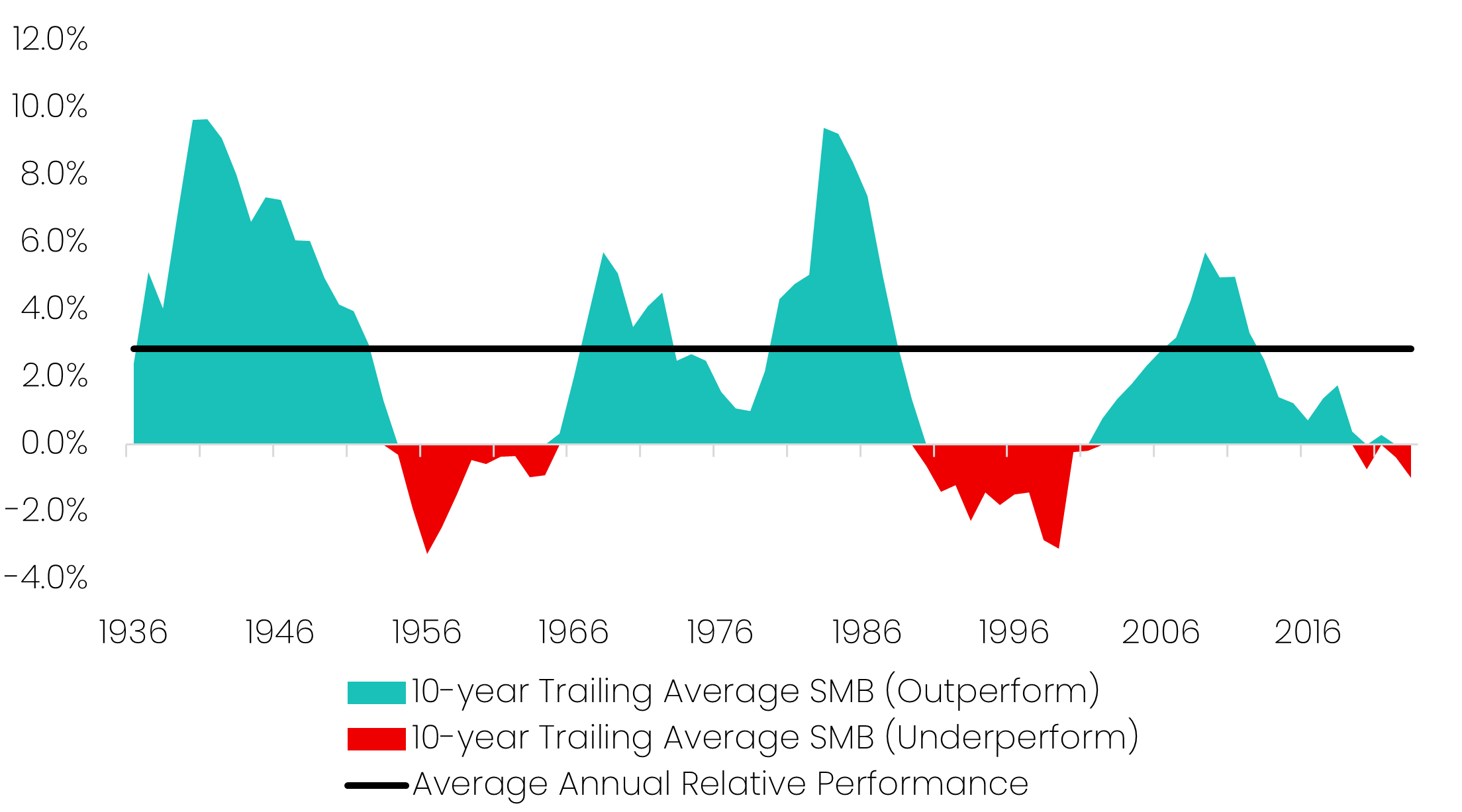
It is well-documented that small cap stocks have historically outperformed large cap stocks over the long-run. In the 96-year period between 1927 to 2023, small caps outperformed big caps by an annual average of 2.85%. In the same period, over 10-year investment periods, small caps led two-thirds of the time.

Source: Original data sourced from Professor Kenneth French Data Library. Based on research performed by Wellington Management ‘A turning point for US small caps’ (April 2024).
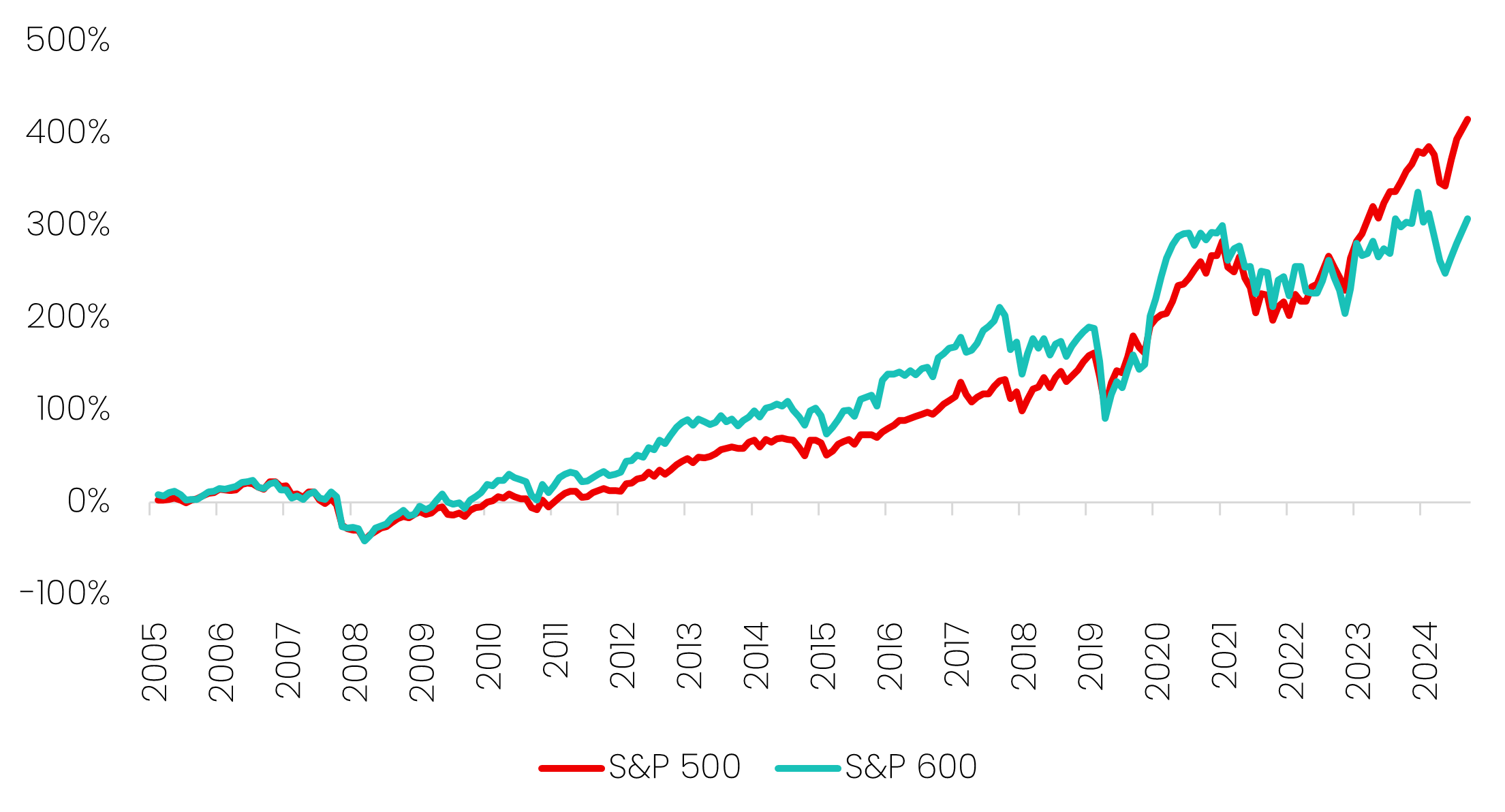
But in the past 5 years, a new paradigm has emerged. Mega-cap technology names (including the so-called “Magnificent 7”) have surged on the back of bullish growth predictions and extreme enthusiasm around Artificial Intelligence. These companies, accounting for approximately one third of the S&P 500, have pulled the rest of the index upwards, resulting in an outperformance of small cap indexes.

Source: Savana, S&P Global
But as we enter the second half of 2025, we believe that the stars are beginning to align for a long-awaited rotation back to the historical norm. Two forces in particular are setting the stage: a softer monetary policy outlook and fading tech-stock exuberance.
After holding rates steady at 4.25%–4.50% for a fifth consecutive meeting in July (with two dissenting governors marking the first dual dissent since 1993) the Fed now appears to be paving the way for an initial rate cut in September. In his recent speech, Chair Jerome Powell emphasised the need to address both sides of the dual mandate, highlighting the risks to the labour market: “...with policy in restrictive territory, the baseline outlook and the shifting balance of risks may warrant adjusting our policy stance.” Reflecting this shift in tone, markets are now pricing an 85% probability of a September cut, and an 85% probability that rates will fall to 3.50% or lower by December 2026.
Looser monetary policy has historically provided a powerful tailwind for small caps. Unlike their large-cap peers, smaller companies are more sensitive to financing conditions: lower borrowing costs ease balance sheet pressures and unlock growth. As capital becomes cheaper and liquidity looser, small caps tend to re-rate higher.
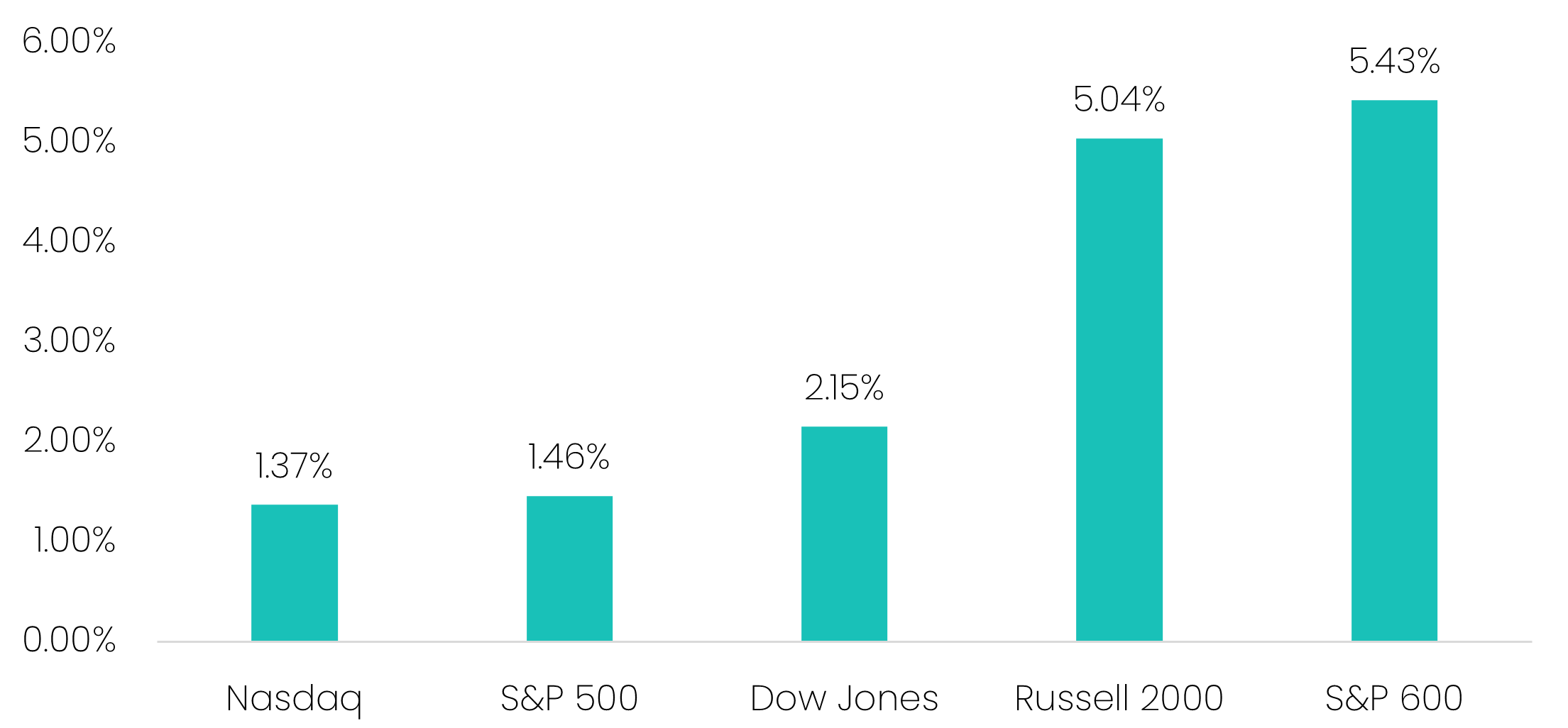
Markets are already alert to this regime shift. Within the two days following a softer-than-expected CPI print on August 12, the S&P 600 jumped 5.43%, outpacing the S&P 500’s 1.46% gain. Similarly, after Powell’s speech, the S&P 600 rallied 3.80% versus just 1.52% for the S&P 500.

Source: Savana, S&P Global. Performance of major US indices between 12-Aug-25 to 13-Aug-25, following release of the Bureau of Labor Statistics CPI report.
The “AI Trade” and high concentration to the US tech giants has been a terrifically profitable position for investors over recent years. However, this gravy train finally appears to be losing steam.
Year-to-date, Magnificent 7 stocks (equal weighted) have underperformed the broader S&P 500. We see two key reasons for this:
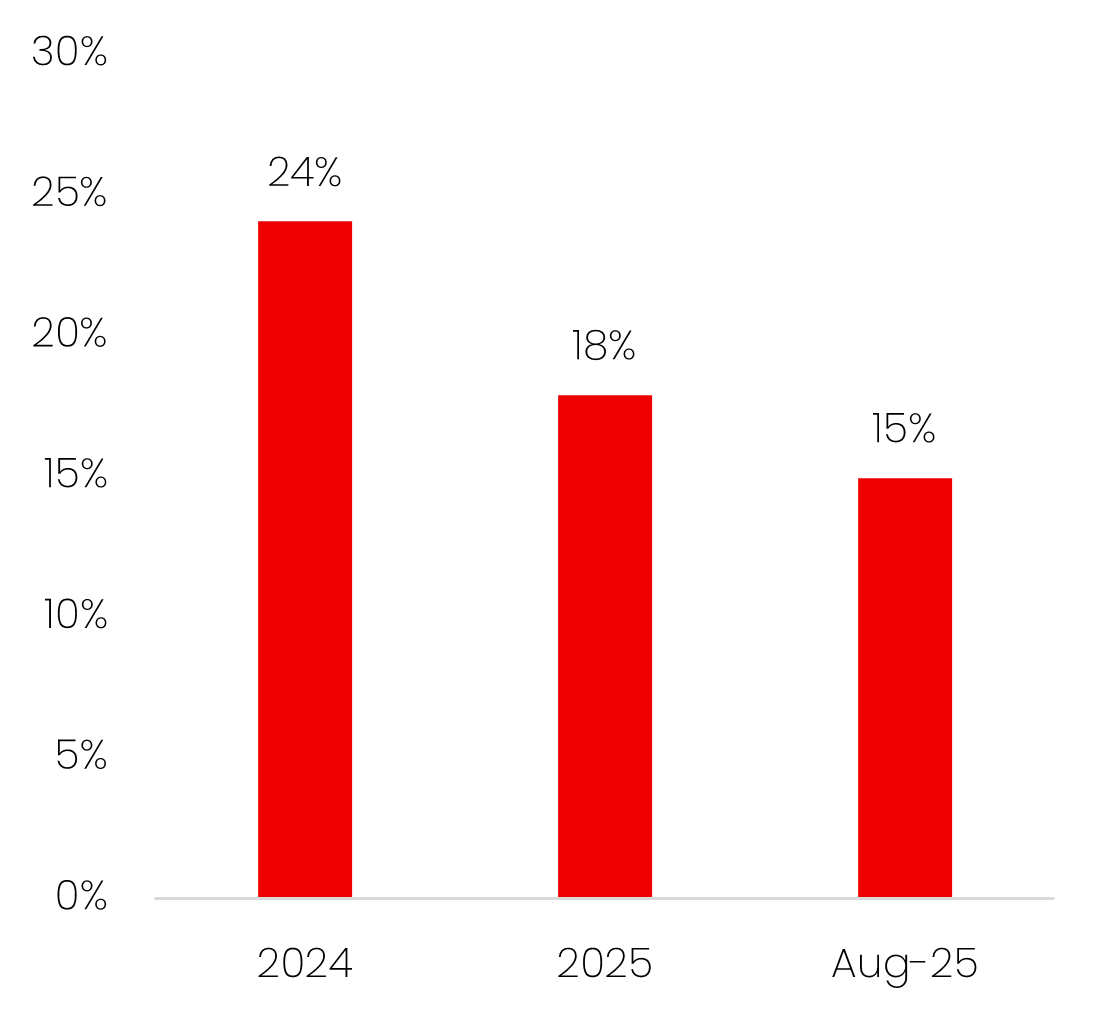
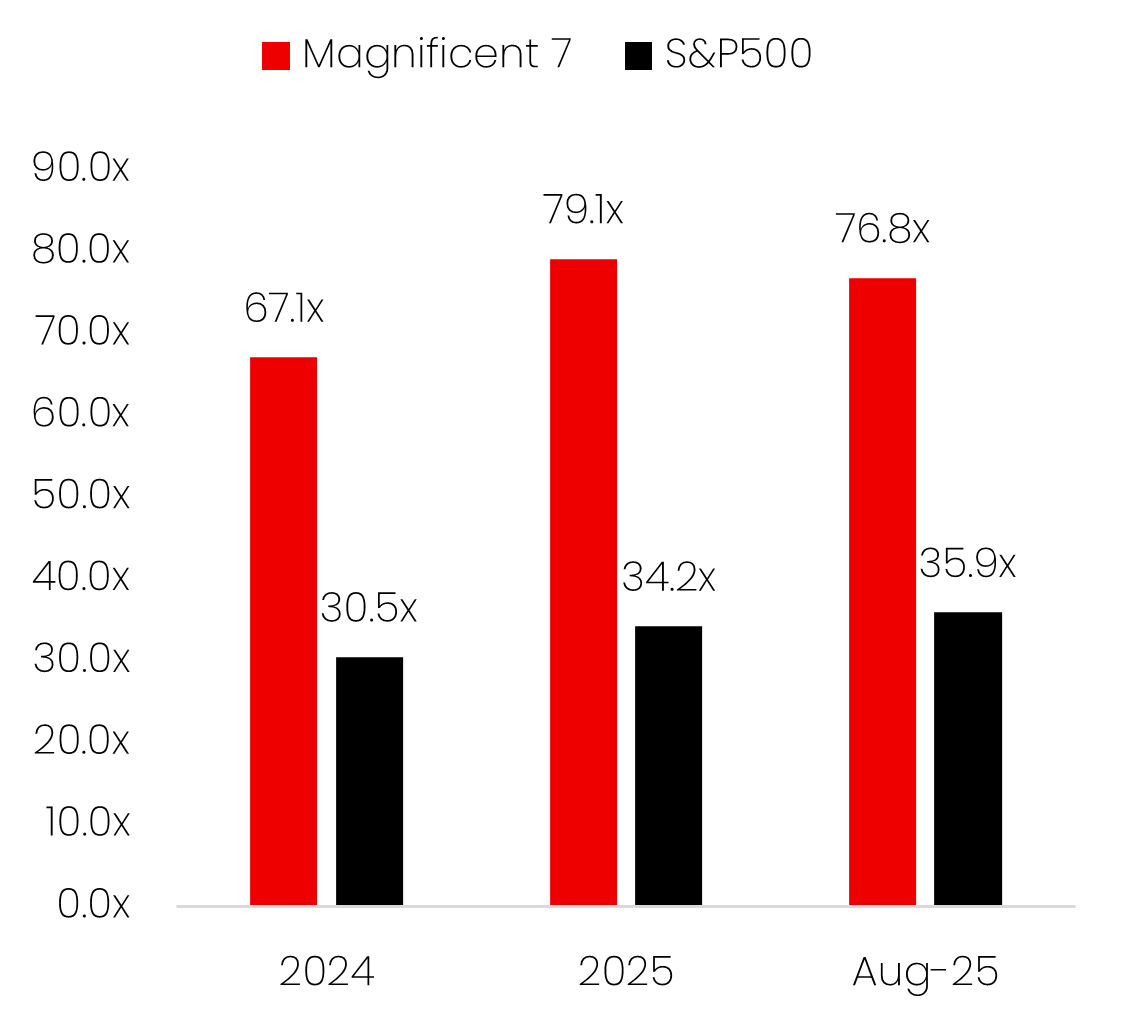
1. Elevated valuations despite slowing EPS growth. On an equal-weighted basis, the Mag-7 still trade on an average P/E ratio of 74.8x, even as forward earnings forecasts have moderated to just 13%. In other words, the “value-for-money” on these names has diminished, leaving little margin for disappointment.


Source: Savana, S&P Global. Mag-7 metrics calculated on an equal-weighted basis.
2. Growing scepticism around AI’s ROI. Momentum has also been dented by doubts over whether massive AI investment is delivering tangible returns. A widely-cited MIT report in July concluded that 95% of organisations are seeing no return on generative AI spend, despite tens of billions of dollars in investment. Sam Altman - arguably AI’s leading voice – has also tempered expectations, recently acknowledging: “Are we in a phase where investors as a whole are overexcited about AI? My opinion is yes.”
Taken together, the shift toward easier monetary policy and the fading of AI-driven mega-cap dominance create a powerful backdrop for small caps. As liquidity returns and investor focus widens beyond large-cap tech, we believe that small caps are well-positioned to re-emerge as a central driver of returns in the cycle ahead.
Over the course of the month, two different stocks within the portfolio were identified as takeover targets, catalysing price increases of ~15% and ~26% respectively within the following two trading days.
In total, there have now been 6 occurrences of major corporate actions since inception of the fund in November 2024, representing a strike rate of 10.5% based on the number of unique holdings since inception (57). This result reinforces a key discovery observed in paper-trading: that Savana’s portfolios tend to exhibit a disproportionately high level of corporate actions, and specifically, M&A activity.
The hypothesis is intuitive. Major corporate actions (such as mergers, acquisitions, private placements, spin-offs and restructurings), are more likely to occur in undervalued companies because lower multiples and / or underperforming assets are more attractive to buyers who can maximise value through operational improvement or financial engineering.
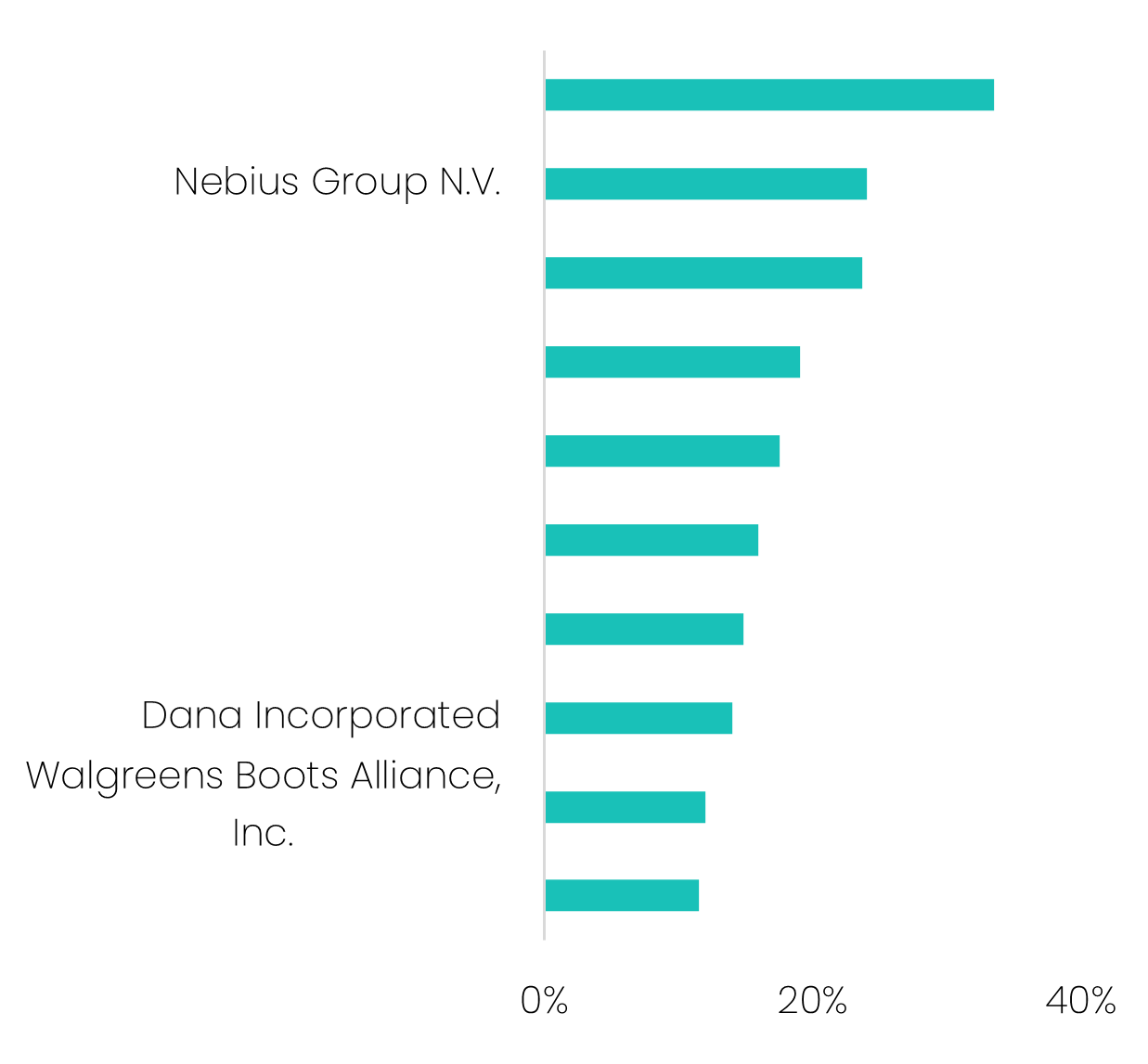
Savana’s algorithmic stock selection tends to naturally uncover such opportunities. Corporate actions are commonly value accretive and offer share price premiums as part of the transaction, unlocking powerful levers for growth. Among the 6 companies in Savana’s portfolio that have experienced a corporate action event, 3 are top 10 contributors of portfolio returns.

Source: Savana, S&P Global. Contribution is as a percentage of overall returns - i.e., percentage contribution of 10% means the stock has delivered 10% of the portfolio’s total return.
Apart from providing a nice booster to portfolio returns, Savana’s disproportionate exposure to corporate actions further legitimises its strategy. By systematically positioning ahead of these events, we capture temporary inefficiencies before the market fully adjusts, realising excess returns as price discovery and efficient allocation follow.
In last month’s letter, we covered the surprising return of meme-stock mania, and the incredible rally of our own Kohl’s Corp (KSS).
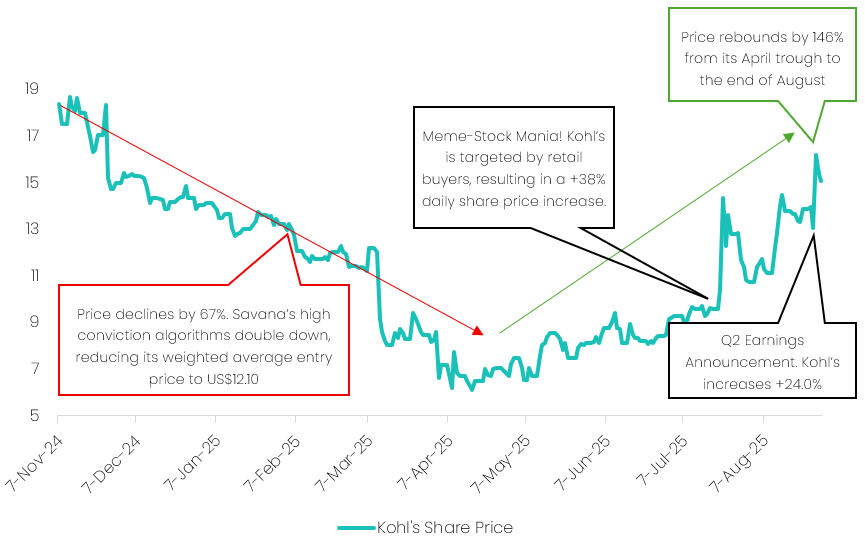
This month, Kohl’s has made headlines yet again with a bumper Q2 earnings release, which featured adjusted Earnings Per Share of 56 cents (versus 29 cents expected) and a full year guidance upgrade to 50-80 cents (versus 10-60 cents previously). The Company share price jumped 24% for the day, marking a meteoric 116% rise over the previous 3 months.

Source: Savana, S&P Global.
As we explained in last month’s letter, Kohl’s is not a typical ‘meme’ stock. Far from being frothy and speculative, Kohl’s stands out with real fundamentals. As at 30 June – before being swept up by meme-stock mania - Kohl’s traded at a 7.5x price-to-earnings, a 5.9% dividend yield, and maintained a valuable real estate portfolio exceeding its book value by up to 4x.
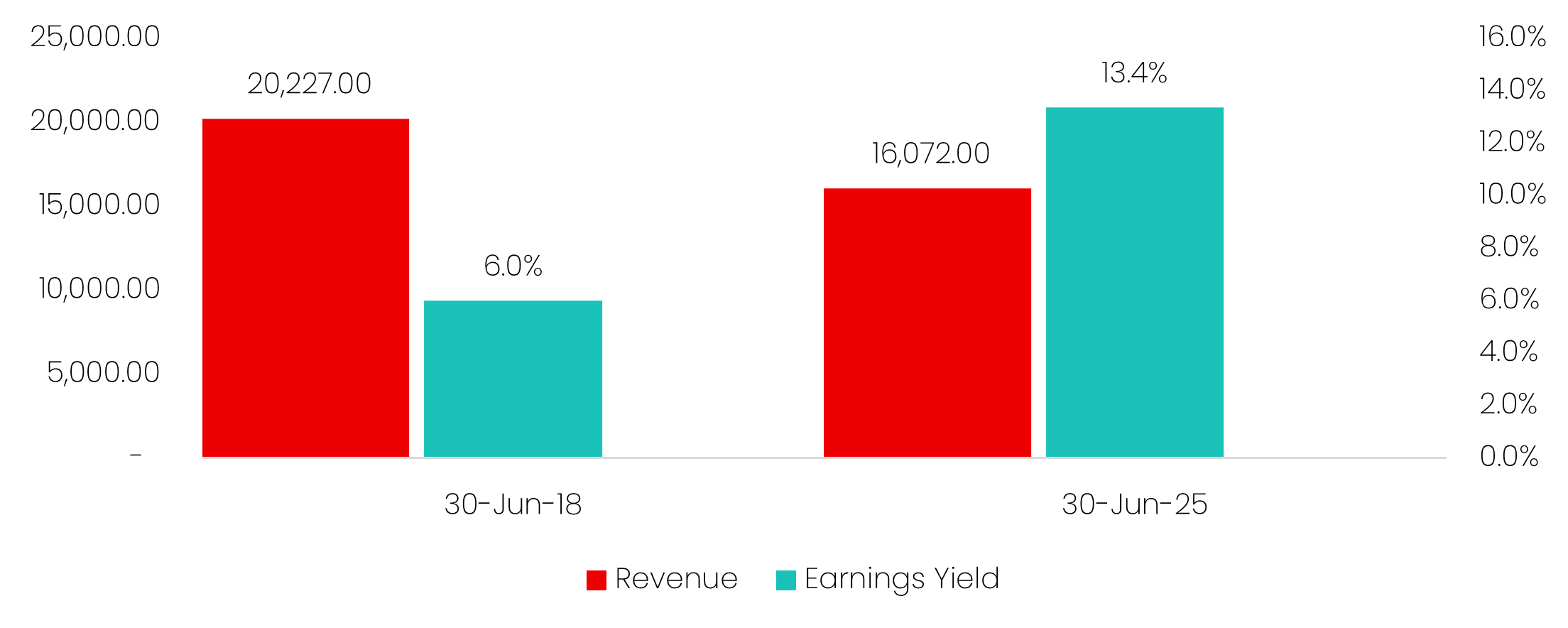
The significant discount on fundamentals was not completely without reason. Since COVID, Kohl’s has been challenged by a pernicious confluence of factors, including weak foot traffic, growing competition from e-commerce, margin pressure from discounting, and a high-interest rate environment. But while revenue has fallen 21% since Jun-18, an investor in Jun-25 could buy more than 2x the earnings for the same price, and receive 76% more yield on its dividend.

Source: Savana, S&P Global.
Kohl’s was rightfully marked down by the market in accordance with weakening financials. But at what point does the high yield, embedded tangible asset value and turnaround potential flip the risk/return profile such that the upside risk outweighs the downside?
Savana’s algorithms are specifically designed to pinpoint and capitalise on these moments of asymmetry. In these situations, further downside tends to be already embedded in the share price, which tilts the risk-reward profile to the positive. When disappointing news arrives, the market reaction is often limited. But when positive catalysts emerge - such as Kohl’s recent Q2 earnings surprise - the potential for upside becomes far greater, allowing for swift price correction.
After riding out significant volatility, Kohl’s is now a positive contributor to Savana’s overall portfolio returns. Following a 66% share price appreciation since last rebalancing, the company represents an outsized position in the current portfolio. We look forward to hopefully taking profits on this name through our bi-monthly, equal weighted portfolio rebalancing process in early September.
1. The Great Rotation: why the stars are aligning for US small caps.
2. Premeditating the Market: how our algorithms seek to anticipate major corporate actions.
3. Kohl’s Watch: our favourite ‘meme’ stock strikes again.
It is well-documented that small cap stocks have historically outperformed large cap stocks over the long-run. In the 96-year period between 1927 to 2023, small caps outperformed big caps by an annual average of 2.85%. In the same period, over 10-year investment periods, small caps led two-thirds of the time.

Source: Original data sourced from Professor Kenneth French Data Library. Based on research performed by Wellington Management ‘A turning point for US small caps’ (April 2024).
But in the past 5 years, a new paradigm has emerged. Mega-cap technology names (including the so-called “Magnificent 7”) have surged on the back of bullish growth predictions and extreme enthusiasm around Artificial Intelligence. These companies, accounting for approximately one third of the S&P 500, have pulled the rest of the index upwards, resulting in an outperformance of small cap indexes.

Source: Savana, S&P Global
But as we enter the second half of 2025, we believe that the stars are beginning to align for a long-awaited rotation back to the historical norm. Two forces in particular are setting the stage: a softer monetary policy outlook and fading tech-stock exuberance.
After holding rates steady at 4.25%–4.50% for a fifth consecutive meeting in July (with two dissenting governors marking the first dual dissent since 1993) the Fed now appears to be paving the way for an initial rate cut in September. In his recent speech, Chair Jerome Powell emphasised the need to address both sides of the dual mandate, highlighting the risks to the labour market: “...with policy in restrictive territory, the baseline outlook and the shifting balance of risks may warrant adjusting our policy stance.” Reflecting this shift in tone, markets are now pricing an 85% probability of a September cut, and an 85% probability that rates will fall to 3.50% or lower by December 2026.
Looser monetary policy has historically provided a powerful tailwind for small caps. Unlike their large-cap peers, smaller companies are more sensitive to financing conditions: lower borrowing costs ease balance sheet pressures and unlock growth. As capital becomes cheaper and liquidity looser, small caps tend to re-rate higher.
Markets are already alert to this regime shift. Within the two days following a softer-than-expected CPI print on August 12, the S&P 600 jumped 5.43%, outpacing the S&P 500’s 1.46% gain. Similarly, after Powell’s speech, the S&P 600 rallied 3.80% versus just 1.52% for the S&P 500.

Source: Savana, S&P Global. Performance of major US indices between 12-Aug-25 to 13-Aug-25, following release of the Bureau of Labor Statistics CPI report.
The “AI Trade” and high concentration to the US tech giants has been a terrifically profitable position for investors over recent years. However, this gravy train finally appears to be losing steam.
Year-to-date, Magnificent 7 stocks (equal weighted) have underperformed the broader S&P 500. We see two key reasons for this:
1. Elevated valuations despite slowing EPS growth. On an equal-weighted basis, the Mag-7 still trade on an average P/E ratio of 74.8x, even as forward earnings forecasts have moderated to just 13%. In other words, the “value-for-money” on these names has diminished, leaving little margin for disappointment.


Source: Savana, S&P Global. Mag-7 metrics calculated on an equal-weighted basis.
2. Growing scepticism around AI’s ROI. Momentum has also been dented by doubts over whether massive AI investment is delivering tangible returns. A widely-cited MIT report in July concluded that 95% of organisations are seeing no return on generative AI spend, despite tens of billions of dollars in investment. Sam Altman - arguably AI’s leading voice – has also tempered expectations, recently acknowledging: “Are we in a phase where investors as a whole are overexcited about AI? My opinion is yes.”
Taken together, the shift toward easier monetary policy and the fading of AI-driven mega-cap dominance create a powerful backdrop for small caps. As liquidity returns and investor focus widens beyond large-cap tech, we believe that small caps are well-positioned to re-emerge as a central driver of returns in the cycle ahead.
Over the course of the month, two different stocks within the portfolio were identified as takeover targets, catalysing price increases of ~15% and ~26% respectively within the following two trading days.
In total, there have now been 6 occurrences of major corporate actions since inception of the fund in November 2024, representing a strike rate of 10.5% based on the number of unique holdings since inception (57). This result reinforces a key discovery observed in paper-trading: that Savana’s portfolios tend to exhibit a disproportionately high level of corporate actions, and specifically, M&A activity.
The hypothesis is intuitive. Major corporate actions (such as mergers, acquisitions, private placements, spin-offs and restructurings), are more likely to occur in undervalued companies because lower multiples and / or underperforming assets are more attractive to buyers who can maximise value through operational improvement or financial engineering.
Savana’s algorithmic stock selection tends to naturally uncover such opportunities. Corporate actions are commonly value accretive and offer share price premiums as part of the transaction, unlocking powerful levers for growth. Among the 6 companies in Savana’s portfolio that have experienced a corporate action event, 3 are top 10 contributors of portfolio returns.

Source: Savana, S&P Global. Contribution is as a percentage of overall returns - i.e., percentage contribution of 10% means the stock has delivered 10% of the portfolio’s total return.
Apart from providing a nice booster to portfolio returns, Savana’s disproportionate exposure to corporate actions further legitimises its strategy. By systematically positioning ahead of these events, we capture temporary inefficiencies before the market fully adjusts, realising excess returns as price discovery and efficient allocation follow.
In last month’s letter, we covered the surprising return of meme-stock mania, and the incredible rally of our own Kohl’s Corp (KSS).
This month, Kohl’s has made headlines yet again with a bumper Q2 earnings release, which featured adjusted Earnings Per Share of 56 cents (versus 29 cents expected) and a full year guidance upgrade to 50-80 cents (versus 10-60 cents previously). The Company share price jumped 24% for the day, marking a meteoric 116% rise over the previous 3 months.

Source: Savana, S&P Global.
As we explained in last month’s letter, Kohl’s is not a typical ‘meme’ stock. Far from being frothy and speculative, Kohl’s stands out with real fundamentals. As at 30 June – before being swept up by meme-stock mania - Kohl’s traded at a 7.5x price-to-earnings, a 5.9% dividend yield, and maintained a valuable real estate portfolio exceeding its book value by up to 4x.
The significant discount on fundamentals was not completely without reason. Since COVID, Kohl’s has been challenged by a pernicious confluence of factors, including weak foot traffic, growing competition from e-commerce, margin pressure from discounting, and a high-interest rate environment. But while revenue has fallen 21% since Jun-18, an investor in Jun-25 could buy more than 2x the earnings for the same price, and receive 76% more yield on its dividend.

Source: Savana, S&P Global.
Kohl’s was rightfully marked down by the market in accordance with weakening financials. But at what point does the high yield, embedded tangible asset value and turnaround potential flip the risk/return profile such that the upside risk outweighs the downside?
Savana’s algorithms are specifically designed to pinpoint and capitalise on these moments of asymmetry. In these situations, further downside tends to be already embedded in the share price, which tilts the risk-reward profile to the positive. When disappointing news arrives, the market reaction is often limited. But when positive catalysts emerge - such as Kohl’s recent Q2 earnings surprise - the potential for upside becomes far greater, allowing for swift price correction.
After riding out significant volatility, Kohl’s is now a positive contributor to Savana’s overall portfolio returns. Following a 66% share price appreciation since last rebalancing, the company represents an outsized position in the current portfolio. We look forward to hopefully taking profits on this name through our bi-monthly, equal weighted portfolio rebalancing process in early September.



1. The Great Rotation: why the stars are aligning for US small caps.
2. Premeditating the Market: how our algorithms seek to anticipate major corporate actions.
3. Kohl’s Watch: our favourite ‘meme’ stock strikes again.
It is well-documented that small cap stocks have historically outperformed large cap stocks over the long-run. In the 96-year period between 1927 to 2023, small caps outperformed big caps by an annual average of 2.85%. In the same period, over 10-year investment periods, small caps led two-thirds of the time.

Source: Original data sourced from Professor Kenneth French Data Library. Based on research performed by Wellington Management ‘A turning point for US small caps’ (April 2024).
But in the past 5 years, a new paradigm has emerged. Mega-cap technology names (including the so-called “Magnificent 7”) have surged on the back of bullish growth predictions and extreme enthusiasm around Artificial Intelligence. These companies, accounting for approximately one third of the S&P 500, have pulled the rest of the index upwards, resulting in an outperformance of small cap indexes.

Source: Savana, S&P Global
But as we enter the second half of 2025, we believe that the stars are beginning to align for a long-awaited rotation back to the historical norm. Two forces in particular are setting the stage: a softer monetary policy outlook and fading tech-stock exuberance.
After holding rates steady at 4.25%–4.50% for a fifth consecutive meeting in July (with two dissenting governors marking the first dual dissent since 1993) the Fed now appears to be paving the way for an initial rate cut in September. In his recent speech, Chair Jerome Powell emphasised the need to address both sides of the dual mandate, highlighting the risks to the labour market: “...with policy in restrictive territory, the baseline outlook and the shifting balance of risks may warrant adjusting our policy stance.” Reflecting this shift in tone, markets are now pricing an 85% probability of a September cut, and an 85% probability that rates will fall to 3.50% or lower by December 2026.
Looser monetary policy has historically provided a powerful tailwind for small caps. Unlike their large-cap peers, smaller companies are more sensitive to financing conditions: lower borrowing costs ease balance sheet pressures and unlock growth. As capital becomes cheaper and liquidity looser, small caps tend to re-rate higher.
Markets are already alert to this regime shift. Within the two days following a softer-than-expected CPI print on August 12, the S&P 600 jumped 5.43%, outpacing the S&P 500’s 1.46% gain. Similarly, after Powell’s speech, the S&P 600 rallied 3.80% versus just 1.52% for the S&P 500.

Source: Savana, S&P Global. Performance of major US indices between 12-Aug-25 to 13-Aug-25, following release of the Bureau of Labor Statistics CPI report.
The “AI Trade” and high concentration to the US tech giants has been a terrifically profitable position for investors over recent years. However, this gravy train finally appears to be losing steam.
Year-to-date, Magnificent 7 stocks (equal weighted) have underperformed the broader S&P 500. We see two key reasons for this:
1. Elevated valuations despite slowing EPS growth. On an equal-weighted basis, the Mag-7 still trade on an average P/E ratio of 74.8x, even as forward earnings forecasts have moderated to just 13%. In other words, the “value-for-money” on these names has diminished, leaving little margin for disappointment.


Source: Savana, S&P Global. Mag-7 metrics calculated on an equal-weighted basis.
2. Growing scepticism around AI’s ROI. Momentum has also been dented by doubts over whether massive AI investment is delivering tangible returns. A widely-cited MIT report in July concluded that 95% of organisations are seeing no return on generative AI spend, despite tens of billions of dollars in investment. Sam Altman - arguably AI’s leading voice – has also tempered expectations, recently acknowledging: “Are we in a phase where investors as a whole are overexcited about AI? My opinion is yes.”
Taken together, the shift toward easier monetary policy and the fading of AI-driven mega-cap dominance create a powerful backdrop for small caps. As liquidity returns and investor focus widens beyond large-cap tech, we believe that small caps are well-positioned to re-emerge as a central driver of returns in the cycle ahead.
Over the course of the month, two different stocks within the portfolio were identified as takeover targets, catalysing price increases of ~15% and ~26% respectively within the following two trading days.
In total, there have now been 6 occurrences of major corporate actions since inception of the fund in November 2024, representing a strike rate of 10.5% based on the number of unique holdings since inception (57). This result reinforces a key discovery observed in paper-trading: that Savana’s portfolios tend to exhibit a disproportionately high level of corporate actions, and specifically, M&A activity.
The hypothesis is intuitive. Major corporate actions (such as mergers, acquisitions, private placements, spin-offs and restructurings), are more likely to occur in undervalued companies because lower multiples and / or underperforming assets are more attractive to buyers who can maximise value through operational improvement or financial engineering.
Savana’s algorithmic stock selection tends to naturally uncover such opportunities. Corporate actions are commonly value accretive and offer share price premiums as part of the transaction, unlocking powerful levers for growth. Among the 6 companies in Savana’s portfolio that have experienced a corporate action event, 3 are top 10 contributors of portfolio returns.

Source: Savana, S&P Global. Contribution is as a percentage of overall returns - i.e., percentage contribution of 10% means the stock has delivered 10% of the portfolio’s total return.
Apart from providing a nice booster to portfolio returns, Savana’s disproportionate exposure to corporate actions further legitimises its strategy. By systematically positioning ahead of these events, we capture temporary inefficiencies before the market fully adjusts, realising excess returns as price discovery and efficient allocation follow.
In last month’s letter, we covered the surprising return of meme-stock mania, and the incredible rally of our own Kohl’s Corp (KSS).
This month, Kohl’s has made headlines yet again with a bumper Q2 earnings release, which featured adjusted Earnings Per Share of 56 cents (versus 29 cents expected) and a full year guidance upgrade to 50-80 cents (versus 10-60 cents previously). The Company share price jumped 24% for the day, marking a meteoric 116% rise over the previous 3 months.

Source: Savana, S&P Global.
As we explained in last month’s letter, Kohl’s is not a typical ‘meme’ stock. Far from being frothy and speculative, Kohl’s stands out with real fundamentals. As at 30 June – before being swept up by meme-stock mania - Kohl’s traded at a 7.5x price-to-earnings, a 5.9% dividend yield, and maintained a valuable real estate portfolio exceeding its book value by up to 4x.
The significant discount on fundamentals was not completely without reason. Since COVID, Kohl’s has been challenged by a pernicious confluence of factors, including weak foot traffic, growing competition from e-commerce, margin pressure from discounting, and a high-interest rate environment. But while revenue has fallen 21% since Jun-18, an investor in Jun-25 could buy more than 2x the earnings for the same price, and receive 76% more yield on its dividend.

Source: Savana, S&P Global.
Kohl’s was rightfully marked down by the market in accordance with weakening financials. But at what point does the high yield, embedded tangible asset value and turnaround potential flip the risk/return profile such that the upside risk outweighs the downside?
Savana’s algorithms are specifically designed to pinpoint and capitalise on these moments of asymmetry. In these situations, further downside tends to be already embedded in the share price, which tilts the risk-reward profile to the positive. When disappointing news arrives, the market reaction is often limited. But when positive catalysts emerge - such as Kohl’s recent Q2 earnings surprise - the potential for upside becomes far greater, allowing for swift price correction.
After riding out significant volatility, Kohl’s is now a positive contributor to Savana’s overall portfolio returns. Following a 66% share price appreciation since last rebalancing, the company represents an outsized position in the current portfolio. We look forward to hopefully taking profits on this name through our bi-monthly, equal weighted portfolio rebalancing process in early September.