Letter to Investors - February 2026
February 2026
Back to InsightsSubscribe

Letter to Investors - February 2026

Savana

28 February 2026

Letter to Investors - February 2026

February Unpacked

After bragging about SVNP’s 100% batting average in the previous edition of this newsletter, February delivered a timely reminder of the market’s penchant for humbling investors.

In a challenging month for fund managers, the fund declined -2.02% (net of fees). At the stock level, performance across the portfolio was broadly flat. Instead, currency movements were the primary driver of returns, with the USD depreciating a further -1.8% over the month, weighing on performance.

Tech’s Reality Check

February will likely be remembered as a month of reckoning for software stocks - what some have dubbed the “SaaSpocalypse.” Concerns around AI-driven disruption – triggered by the release of Anthropic’s Claude Code - swept through the sector, triggering a sharp sell-off. In Australia, several well-known technology companies were among the hardest hit, including WiseTech (-18.0%), Xero (-11.3%) and Life360 (-10.4%). The S&P/ASX All Technology Index has now declined roughly 33% over the past six months.
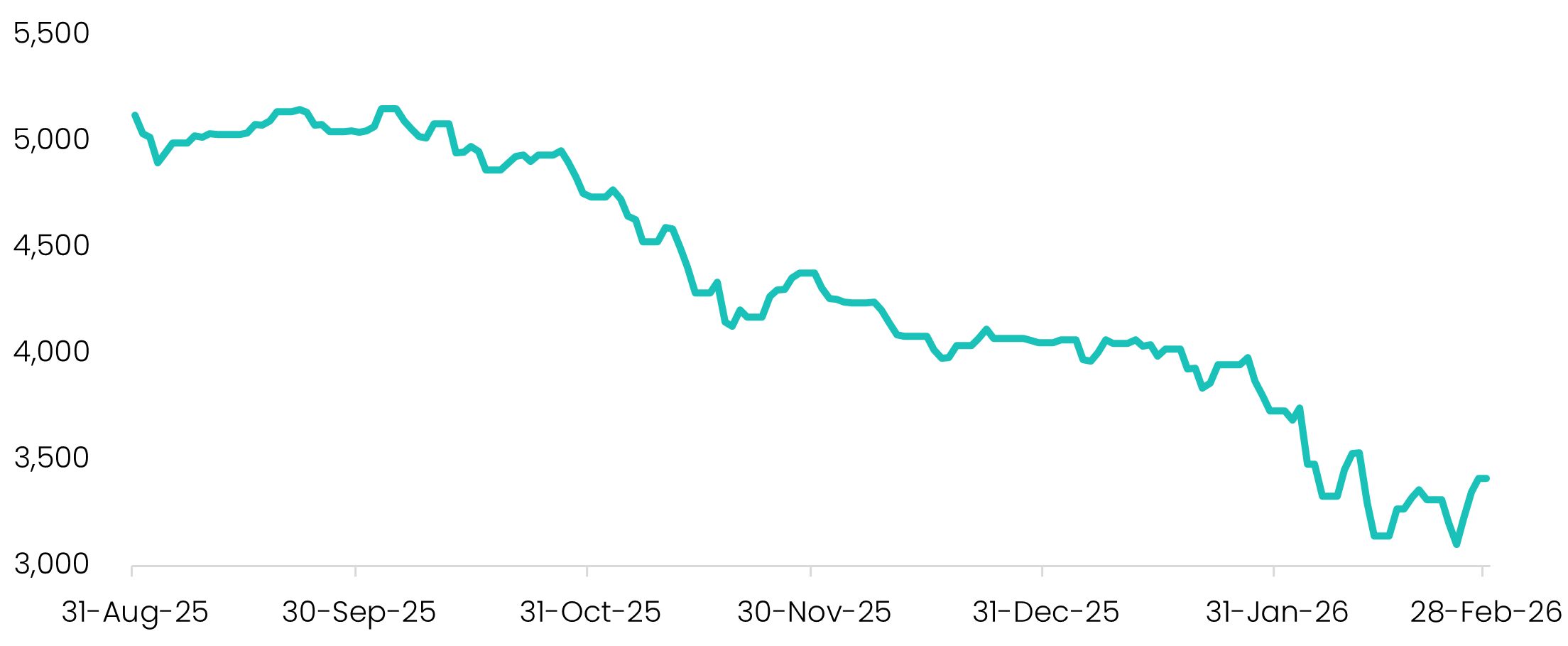
S&P/ASX All Technology Total Return Index – Six Month Performance

Source: S&P Global, Savana. All Technology Total Return Index from 31-Aug-25 to 28-Feb-26.

Somewhat ironically, despite being widely viewed as the disruptor, the AI trade itself has also lost momentum. NVIDIA reported another exceptional set of results during the month - including 73% year-on-year revenue growth and a 6.6% earnings beat - yet its share price still fell following the announcement and remains down year-to-date.

Taken together, these moves highlight the uncertainty currently gripping the technology sector. Investors are predicting that traditional software companies will lose to AI - yet remain unconvinced that AI companies themselves will ultimately capture the economic upside, given the enormous capital requirements, intense competition and still-uncertain long-term economics of the industry.

History suggests this dynamic is not unusual. Transformational technologies - from the Industrial Revolution to the railway boom - have often created enormous economic value without necessarily rewarding the most obvious participants. The key question for investors, therefore, is not whether value will be created, but where it ultimately accrues.

One place where the impact is already visible is capital investment. In 2025 alone, Amazon, Microsoft, Alphabet and Meta invested a combined A$329 billion in AI infrastructure, representing a 66% year-on-year increase, according to S&P Global. According to JP Morgan, AI-related capex contributed 1.1% to GDP growth in the first half of 2025.
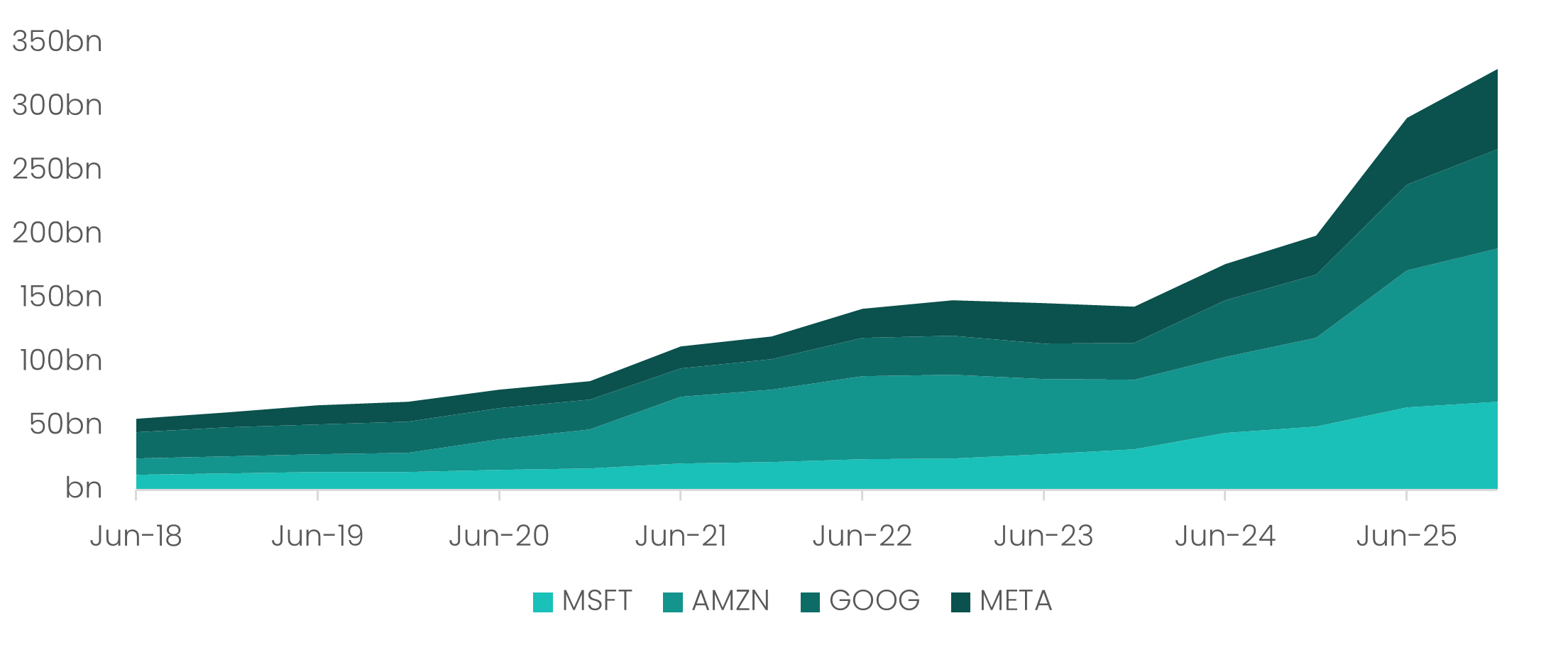
Capital Expenditure by Company Over Time
Mega-Cap Capital Expenditure by Company Over Time to 31-Dec-25

Source: S&P Global, Savana. LTM Capex spend by Company, 30-Jun-18 to 31-Dec-25.

And while the spending originates with the mega-cap technology companies, much of the economic benefit ultimately flows further down the supply chain - to the industrials, manufacturers and specialised equipment providers building the physical backbone of the AI economy. Many of these businesses sit within the U.S. small and mid-cap universe, which creates a fertile hunting ground for active investors.

The Great Rotation Rolls On

In August last year, this newsletter discussed the emergence of a ‘great rotation’ from tech-heavy large caps to value-oriented small caps, driven by shifting economic conditions and the gradual fading of peak AI exuberance. Since then, the S&P 600 small-cap index has outpaced the S&P 500 by more than 3%.  
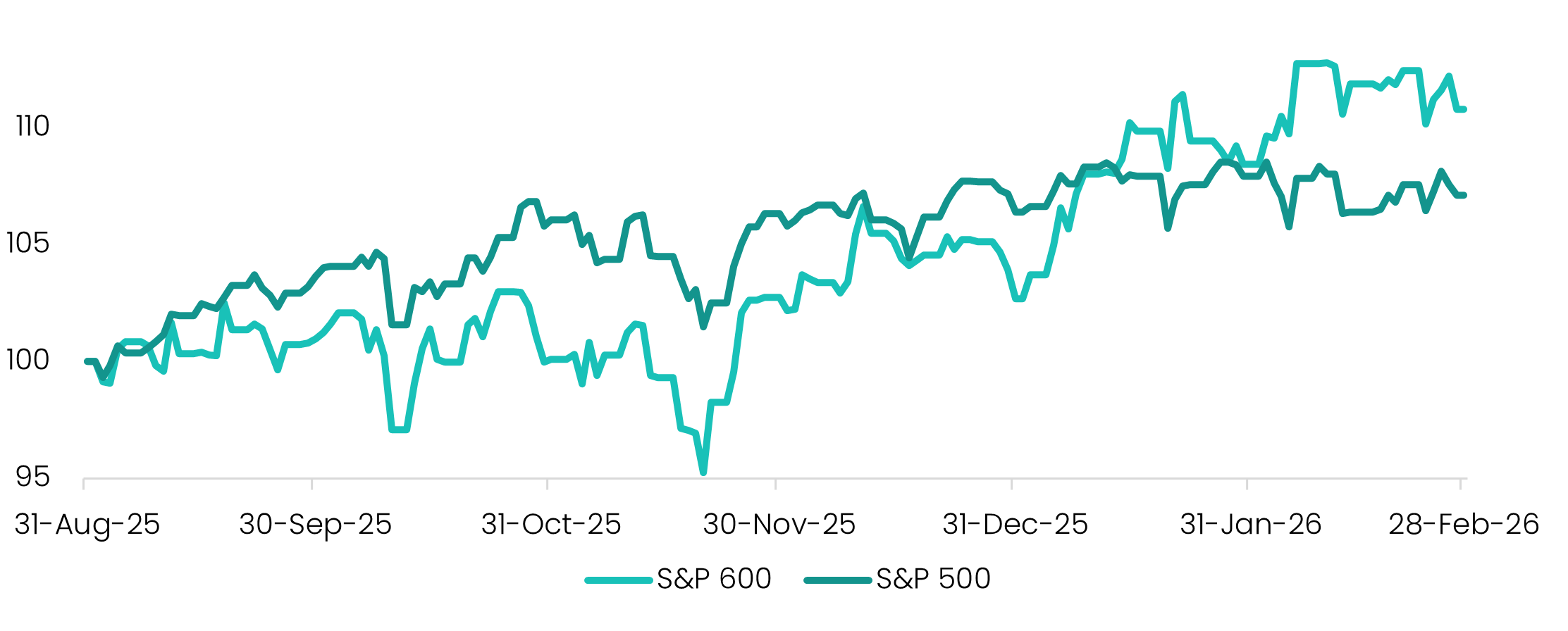
Index Total Gross Returns (rebased to 100).
S&P 500 and S&P 600 Index Total Gross Returns (rebased to 100).

Source: S&P Global, Savana. Index Total Returns from 31-Aug-25 to 28-Feb-26.

This structural transition is also evident within the S&P 500 itself. Year-to-date returns have been led by more cyclical, value-oriented sectors - most notably utilities, energy and materials - while several of the previously dominant technology and consumer discretionary names have lagged. Similarly, the S&P 500 Value segment leads the broader index by more than 3%.
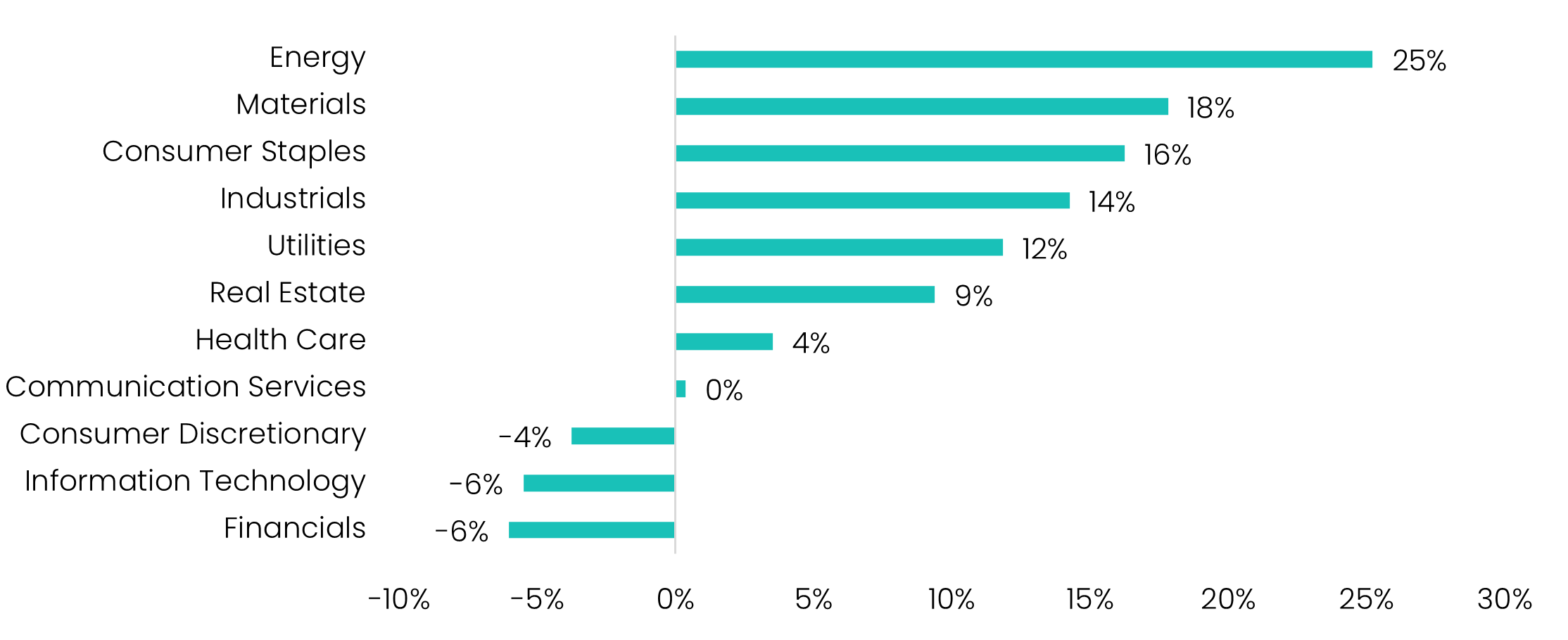
S&P 500 Year-to-Date Returns by Sector
S&P 500 2026 Year-to-Date Returns by Sector

Source: S&P Global, Savana. S&P 500 Sector Returns from 31-Dec-25 to 28-Feb-26.

Importantly, this shift is occurring against a backdrop of resilient corporate fundamentals. According to FactSet, S&P 500 year-on-year earnings growth reached 11.6% in Q1-26, marking the sixth consecutive quarter of double-digit growth. The combination of earnings momentum and a broadening of capital investment provides continued support for small caps, which are typically more sensitive to domestic economic activity and capital spending cycles.

‘Getting Rich Slow’

Among other things, February’s “SaaSpocalypse” served as a useful reminder of the importance of diversification. Several fund managers experienced sharp drawdowns during the month after becoming heavily concentrated in technology and AI-related names. The temptation is understandable. Over the past decade - until quite recently - technology stocks have significantly outpaced major benchmarks, providing a seemingly easy path to outperformance.

While momentum-driven positioning can be highly profitable for extended periods, it can also unravel quickly when sentiment turns - as many investors are now discovering.

Savana’s portfolios, while high-conviction across 30–50 holdings, also tend to be well diversified across industries. By its very nature, our investment approach avoids chasing ‘hot stocks’ or crowded themes, instead favouring companies with strong fundamentals trading at attractive valuations. We believe this disciplined design positions the portfolio for steady, long-term compounding.

SVNP Portfolio Exposure by Industry

Source: Savana. Industry exposures as of 28-Feb-26.

As Warren Buffett famously observed when asked why investors don’t simply copy his approach: “Because nobody wants to get rich slow.”


Link to Original ArticleBack to Insights
Letter to Investors
February 2026
| © Savana Asset Management Pty Ltd

February Unpacked

After bragging about SVNP’s 100% batting average in the previous edition of this newsletter, February delivered a timely reminder of the market’s penchant for humbling investors.

In a challenging month for fund managers, the fund declined -2.02% (net of fees). At the stock level, performance across the portfolio was broadly flat. Instead, currency movements were the primary driver of returns, with the USD depreciating a further -1.8% over the month, weighing on performance.

Tech’s Reality Check

February will likely be remembered as a month of reckoning for software stocks - what some have dubbed the “SaaSpocalypse.” Concerns around AI-driven disruption – triggered by the release of Anthropic’s Claude Code - swept through the sector, triggering a sharp sell-off. In Australia, several well-known technology companies were among the hardest hit, including WiseTech (-18.0%), Xero (-11.3%) and Life360 (-10.4%). The S&P/ASX All Technology Index has now declined roughly 33% over the past six months.

S&P/ASX All Technology Total Return Index – Six Month Performance

Source: S&P Global, Savana. All Technology Total Return Index from 31-Aug-25 to 28-Feb-26.

Somewhat ironically, despite being widely viewed as the disruptor, the AI trade itself has also lost momentum. NVIDIA reported another exceptional set of results during the month - including 73% year-on-year revenue growth and a 6.6% earnings beat - yet its share price still fell following the announcement and remains down year-to-date.

Taken together, these moves highlight the uncertainty currently gripping the technology sector. Investors are predicting that traditional software companies will lose to AI - yet remain unconvinced that AI companies themselves will ultimately capture the economic upside, given the enormous capital requirements, intense competition and still-uncertain long-term economics of the industry.

History suggests this dynamic is not unusual. Transformational technologies - from the Industrial Revolution to the railway boom - have often created enormous economic value without necessarily rewarding the most obvious participants. The key question for investors, therefore, is not whether value will be created, but where it ultimately accrues.

One place where the impact is already visible is capital investment. In 2025 alone, Amazon, Microsoft, Alphabet and Meta invested a combined A$329 billion in AI infrastructure, representing a 66% year-on-year increase, according to S&P Global. According to JP Morgan, AI-related capex contributed 1.1% to GDP growth in the first half of 2025.

Capital Expenditure by Company Over Time
Mega-Cap Capital Expenditure by Company Over Time to 31-Dec-25

Source: S&P Global, Savana. LTM Capex spend by Company, 30-Jun-18 to 31-Dec-25.

And while the spending originates with the mega-cap technology companies, much of the economic benefit ultimately flows further down the supply chain - to the industrials, manufacturers and specialised equipment providers building the physical backbone of the AI economy. Many of these businesses sit within the U.S. small and mid-cap universe, which creates a fertile hunting ground for active investors.

The Great Rotation Rolls On

In August last year, this newsletter discussed the emergence of a ‘great rotation’ from tech-heavy large caps to value-oriented small caps, driven by shifting economic conditions and the gradual fading of peak AI exuberance. Since then, the S&P 600 small-cap index has outpaced the S&P 500 by more than 3%.  

Index Total Gross Returns (rebased to 100).
S&P 500 and S&P 600 Index Total Gross Returns (rebased to 100).

Source: S&P Global, Savana. Index Total Returns from 31-Aug-25 to 28-Feb-26.

This structural transition is also evident within the S&P 500 itself. Year-to-date returns have been led by more cyclical, value-oriented sectors - most notably utilities, energy and materials - while several of the previously dominant technology and consumer discretionary names have lagged. Similarly, the S&P 500 Value segment leads the broader index by more than 3%.

S&P 500 Year-to-Date Returns by Sector
S&P 500 2026 Year-to-Date Returns by Sector

Source: S&P Global, Savana. S&P 500 Sector Returns from 31-Dec-25 to 28-Feb-26.

Importantly, this shift is occurring against a backdrop of resilient corporate fundamentals. According to FactSet, S&P 500 year-on-year earnings growth reached 11.6% in Q1-26, marking the sixth consecutive quarter of double-digit growth. The combination of earnings momentum and a broadening of capital investment provides continued support for small caps, which are typically more sensitive to domestic economic activity and capital spending cycles.

‘Getting Rich Slow’

Among other things, February’s “SaaSpocalypse” served as a useful reminder of the importance of diversification. Several fund managers experienced sharp drawdowns during the month after becoming heavily concentrated in technology and AI-related names. The temptation is understandable. Over the past decade - until quite recently - technology stocks have significantly outpaced major benchmarks, providing a seemingly easy path to outperformance.

While momentum-driven positioning can be highly profitable for extended periods, it can also unravel quickly when sentiment turns - as many investors are now discovering.

Savana’s portfolios, while high-conviction across 30–50 holdings, also tend to be well diversified across industries. By its very nature, our investment approach avoids chasing ‘hot stocks’ or crowded themes, instead favouring companies with strong fundamentals trading at attractive valuations. We believe this disciplined design positions the portfolio for steady, long-term compounding.

SVNP Portfolio Exposure by Industry

Source: Savana. Industry exposures as of 28-Feb-26.

As Warren Buffett famously observed when asked why investors don’t simply copy his approach: “Because nobody wants to get rich slow.”
More Information

If you would like more information about this report or Savana, please contact enquiries@savana.ai. You can also speak to a member of the team below:
Marc Maasdorp, CEO of Savana ETFs.
Marc Maasdorp
Chief Executive Officer
marc.maasdorp@savana.ai
Samuel Atkinson, Associate Director of Savana ETFs.
Samuel Atkinson
Associate Director
samuel.atkinson@savana.ai
DISCLAIMER:
This document has been prepared by Savana Asset Management Pty Ltd (ABN 79 662 088 904) (Savana). Savana is acorporate authorised representative of Fat Prophets Pty Ltd (ABN 62 094 448 549AFS Licence No. 229183) (Fat Prophets), CAR Auth No. 1308949. The Savana US Small Caps Active ETF (ASX: SVNP) (ARSN 649 028 722) is issued by K2 AssetManagement Limited (K2) ABN 95 085 445 094, AFS Licence No 244393, a wholly owned subsidiary of K2 Asset Management Holdings Limited (ABN 59 124 636 782). The information contained in this document is produced in good faith and does not constitute any representation or offer by K2, Savana or Fat Prophets. This material has been prepared for both retail and wholesale investors and is for information purposes only. It is not an offer or a recommendation to invest and it should not be relied upon by investors in making an investment decision. Offers to invest will only be madein the product disclosure statement (“PDS”) available from www.savana.ai and this material is not intended to substitute the PDS which outlines the risks involved and other relevant information. Any investment carries potential risks and fees which are described in the PDS. A Target Market Determination has been prepared for this product and is available from the same website. An investor should, before deciding whether to invest, consider the appropriateness of the investment, having regard to the PDS in its entirety. This information has not been prepared taking into account your objectives, financial situation or needs. Past investment performance is not a reliable indicator of future investment performance. No representation is made as to future performance orvolatility of the investment. In particular, there is no guarantee that the investment objectives and investment strategy set out in this presentation may be successful. Any forward-looking statements, opinions and estimates provided in this material are based on assumptions and contingencies which are subject to change without notice and should not be relied upon as an indication of the future performance. Persons should rely solely upon their own investigations in respect of the subject matter discussed in this material. No representations or warranties, expressed or implied, are made as to the accuracy or completeness of the information, opinions and conclusions contained in this material. In preparing these materials, we have relied upon and assumed, without independent verification, the accuracy and completeness of all information available to Savana. To the maximum extent permitted by law, all liability in reliance on this material is expressly disclaimed. This document is strictly confidential and is intended solely for the use of the person to whom it has been delivered. It may not be reproduced, distributed or published, in whole or in part, without the prior approval of Savana.
See in PDFBack to Insights

Letter to Investors - February 2026

28 February 2026

February Unpacked

After bragging about SVNP’s 100% batting average in the previous edition of this newsletter, February delivered a timely reminder of the market’s penchant for humbling investors.

In a challenging month for fund managers, the fund declined -2.02% (net of fees). At the stock level, performance across the portfolio was broadly flat. Instead, currency movements were the primary driver of returns, with the USD depreciating a further -1.8% over the month, weighing on performance.

Tech’s Reality Check

February will likely be remembered as a month of reckoning for software stocks - what some have dubbed the “SaaSpocalypse.” Concerns around AI-driven disruption – triggered by the release of Anthropic’s Claude Code - swept through the sector, triggering a sharp sell-off. In Australia, several well-known technology companies were among the hardest hit, including WiseTech (-18.0%), Xero (-11.3%) and Life360 (-10.4%). The S&P/ASX All Technology Index has now declined roughly 33% over the past six months.

S&P/ASX All Technology Total Return Index – Six Month Performance

Source: S&P Global, Savana. All Technology Total Return Index from 31-Aug-25 to 28-Feb-26.

Somewhat ironically, despite being widely viewed as the disruptor, the AI trade itself has also lost momentum. NVIDIA reported another exceptional set of results during the month - including 73% year-on-year revenue growth and a 6.6% earnings beat - yet its share price still fell following the announcement and remains down year-to-date.

Taken together, these moves highlight the uncertainty currently gripping the technology sector. Investors are predicting that traditional software companies will lose to AI - yet remain unconvinced that AI companies themselves will ultimately capture the economic upside, given the enormous capital requirements, intense competition and still-uncertain long-term economics of the industry.

History suggests this dynamic is not unusual. Transformational technologies - from the Industrial Revolution to the railway boom - have often created enormous economic value without necessarily rewarding the most obvious participants. The key question for investors, therefore, is not whether value will be created, but where it ultimately accrues.

One place where the impact is already visible is capital investment. In 2025 alone, Amazon, Microsoft, Alphabet and Meta invested a combined A$329 billion in AI infrastructure, representing a 66% year-on-year increase, according to S&P Global. According to JP Morgan, AI-related capex contributed 1.1% to GDP growth in the first half of 2025.

Capital Expenditure by Company Over Time
Mega-Cap Capital Expenditure by Company Over Time to 31-Dec-25

Source: S&P Global, Savana. LTM Capex spend by Company, 30-Jun-18 to 31-Dec-25.

And while the spending originates with the mega-cap technology companies, much of the economic benefit ultimately flows further down the supply chain - to the industrials, manufacturers and specialised equipment providers building the physical backbone of the AI economy. Many of these businesses sit within the U.S. small and mid-cap universe, which creates a fertile hunting ground for active investors.

The Great Rotation Rolls On

In August last year, this newsletter discussed the emergence of a ‘great rotation’ from tech-heavy large caps to value-oriented small caps, driven by shifting economic conditions and the gradual fading of peak AI exuberance. Since then, the S&P 600 small-cap index has outpaced the S&P 500 by more than 3%.  

Index Total Gross Returns (rebased to 100).
S&P 500 and S&P 600 Index Total Gross Returns (rebased to 100).

Source: S&P Global, Savana. Index Total Returns from 31-Aug-25 to 28-Feb-26.

This structural transition is also evident within the S&P 500 itself. Year-to-date returns have been led by more cyclical, value-oriented sectors - most notably utilities, energy and materials - while several of the previously dominant technology and consumer discretionary names have lagged. Similarly, the S&P 500 Value segment leads the broader index by more than 3%.

S&P 500 Year-to-Date Returns by Sector
S&P 500 2026 Year-to-Date Returns by Sector

Source: S&P Global, Savana. S&P 500 Sector Returns from 31-Dec-25 to 28-Feb-26.

Importantly, this shift is occurring against a backdrop of resilient corporate fundamentals. According to FactSet, S&P 500 year-on-year earnings growth reached 11.6% in Q1-26, marking the sixth consecutive quarter of double-digit growth. The combination of earnings momentum and a broadening of capital investment provides continued support for small caps, which are typically more sensitive to domestic economic activity and capital spending cycles.

‘Getting Rich Slow’

Among other things, February’s “SaaSpocalypse” served as a useful reminder of the importance of diversification. Several fund managers experienced sharp drawdowns during the month after becoming heavily concentrated in technology and AI-related names. The temptation is understandable. Over the past decade - until quite recently - technology stocks have significantly outpaced major benchmarks, providing a seemingly easy path to outperformance.

While momentum-driven positioning can be highly profitable for extended periods, it can also unravel quickly when sentiment turns - as many investors are now discovering.

Savana’s portfolios, while high-conviction across 30–50 holdings, also tend to be well diversified across industries. By its very nature, our investment approach avoids chasing ‘hot stocks’ or crowded themes, instead favouring companies with strong fundamentals trading at attractive valuations. We believe this disciplined design positions the portfolio for steady, long-term compounding.

SVNP Portfolio Exposure by Industry

Source: Savana. Industry exposures as of 28-Feb-26.

As Warren Buffett famously observed when asked why investors don’t simply copy his approach: “Because nobody wants to get rich slow.”

Back to Insights