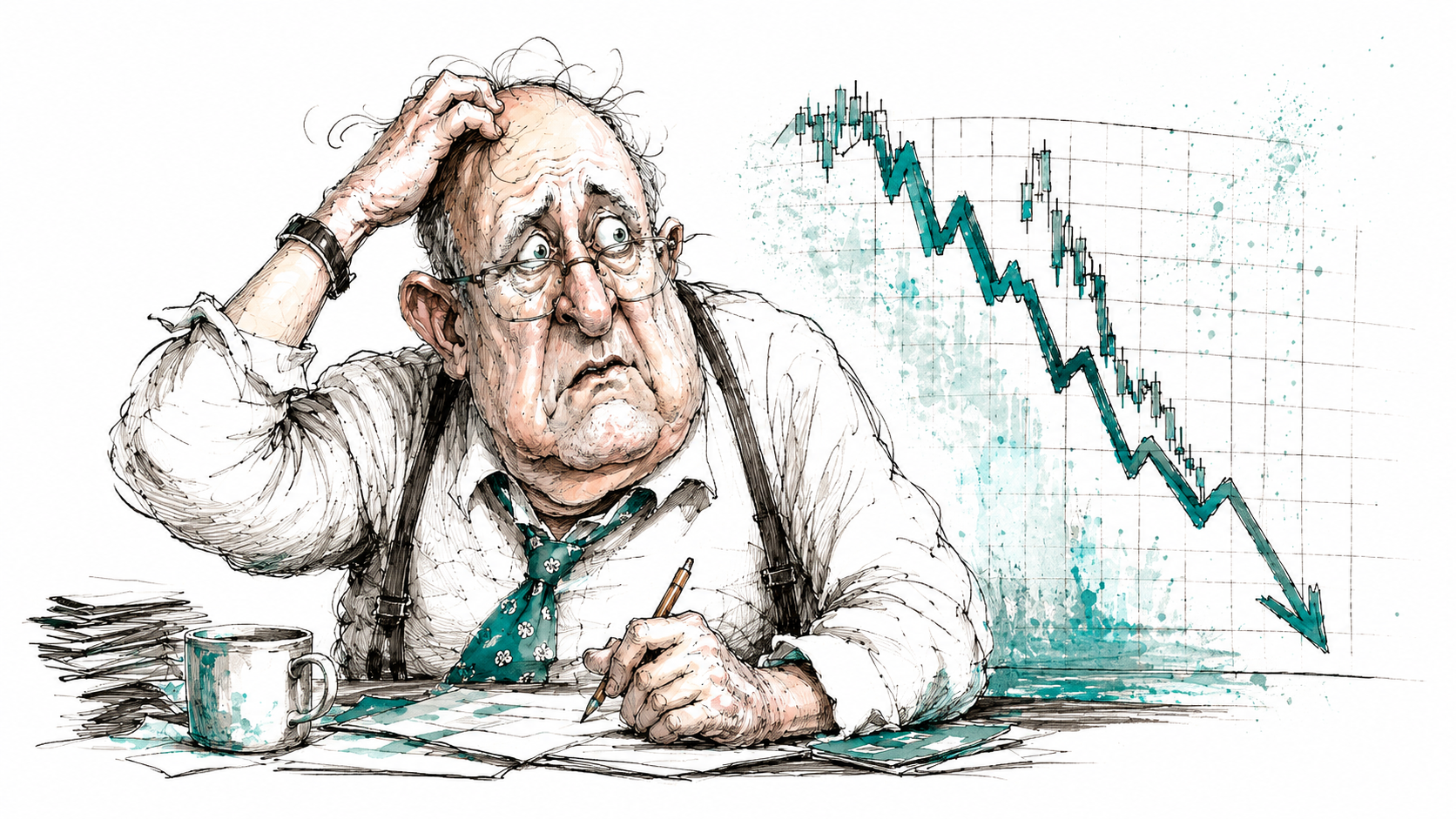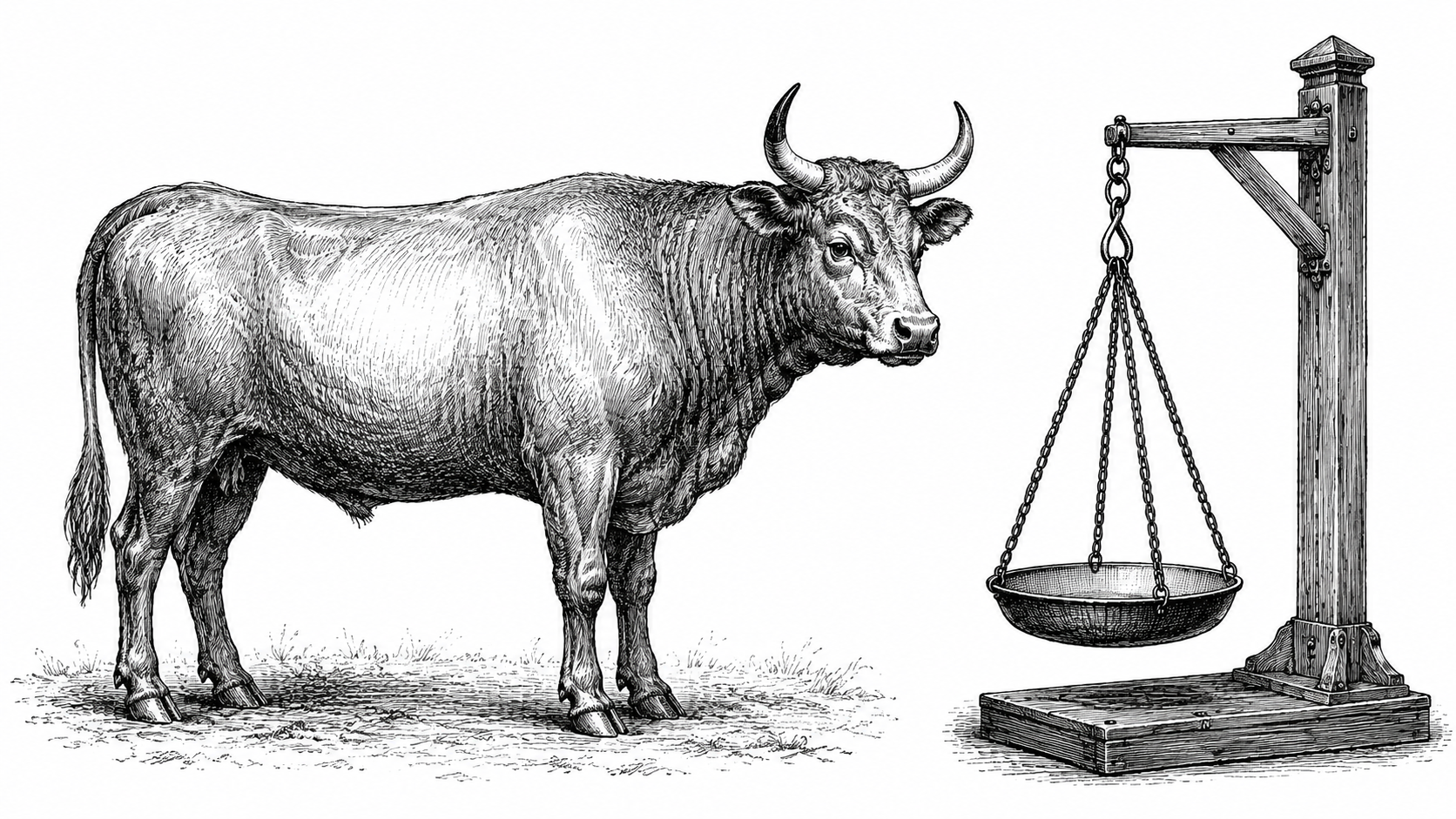
One model is a liability. An ensemble of many models beats the best of them, just as a diverse crowd beats its cleverest member.
Our last piece on the Wisdom of Crowds argued that markets are wise under particular conditions, and that the wisdom comes as much from the diversity of the crowd as from the skill of anyone in it. The mathematics is emphatic on this point: a crowd's error shrinks as the diversity of its views grows, quite apart from how good any individual member is. The uncomfortable implication for a stock picker is that being right more often than the crowd is not easy. You are competing against the cancellation of millions of independent errors, and that is a hard thing to beat.
This piece is about a second idea, and one we think is more useful to an investor. If diversity is what makes a crowd wise, the natural question is whether you can build that diversity on purpose rather than wait for the market to supply it. The mathematics and the many-model literature, set out most fully in Scott Page's The Model Thinker, says you can, and that the tool for doing it is not a better model but an ensemble of many.
The ensemble beats the best
Michael Mauboussin has spent years explaining why a crowd forecasts well, and the answer is rarely individual brilliance. A crowd is accurate because its members read the same problem differently, so their independent errors point in different directions and cancel, leaving the signal behind. The same logic carries from people to models. Hand a hard problem to a single model, however sophisticated, and its errors are built in. Combine several genuinely different models, each carrying some signal and each wrong in its own way, and those errors begin to offset.
The result is well established in the forecasting literature and blunt in its conclusion: an appropriately constructed ensemble of many models is always more accurate than the average model and is typically more accurate than the best single model among them. Not the best model on its best day. The combination, reliably, over time. This is not a finance idea, but one demonstrated in many natural problem-solving phenomena in physics and biology, which is part of why we trust it. The United States Federal Reserve does not forecast with one model; it runs an ensemble and leans on the combination. National weather services moved to ensemble forecasting decades ago, which is why a modern forecast arrives as a probability rather than a single confident line. The prediction systems now embedded in logistics, medicine and search are almost all ensembles rather than single elegant equations. In field after field where being approximately right matters more than being theoretically pure, the single best model has quietly lost to the committee of adequate ones.
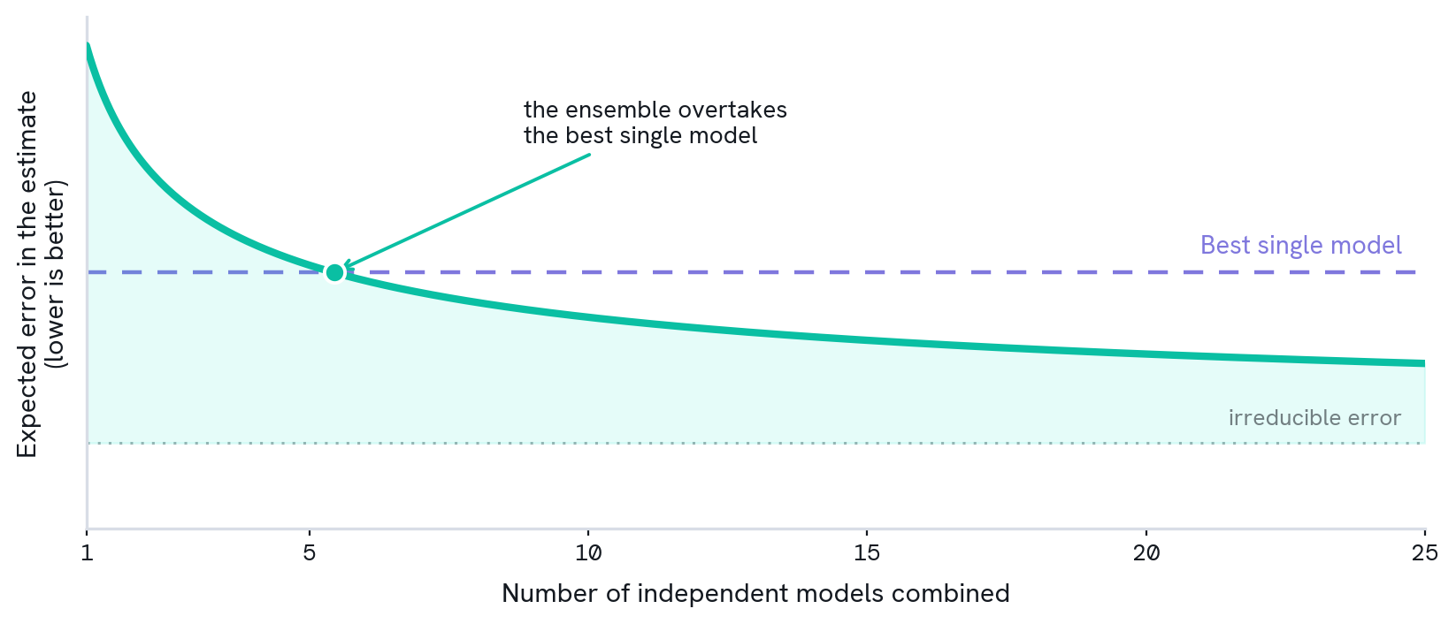
Figure 1. Why an ensemble wins. As more genuinely independent models are combined, the expected error in the estimate falls, crosses below the best single model, and flattens at a floor of error common to them all that no amount of combining can remove. Schematic illustration of the mechanism, not actual model output.
The man with a hammer
Investing is the conspicuous holdout. Much of active management is still organised around one dominant lens. A deep value house sees cheapness. A quality manager sees compounding. A momentum strategy sees trend. Each is a coherent way to read a company, and each works, right up until the market stops rewarding the thing that model measures. Charlie Munger made the warning a staple of his own case for thinking in many models at once: to the man with a hammer, everything looks like a nail. A single model does not merely miss now and then. It misses in a consistent direction, because its blind spots are structural. Its errors are correlated with themselves, which is exactly the condition that destroys the accuracy of any aggregate.
The strength of many models is that they are wrong in different directions. The value model's optimism is checked by the quality model's caution. The trend signal's late entry is offset by a valuation signal's early one. No single view runs the book, and the combined estimate sits closer to fair value than any of its parts. Diversity does the work, precisely as it does in a crowd.
What a many-model approach looks like
In practice this means reading each company through many independent lenses at once. One asks what the business is worth on its cash flows. Another looks at the value of its assets, another at the durability of its earnings, another at the direction of its fundamentals, another at how comparable companies are priced. Each lens is a model in its own right, with its own assumptions and its own characteristic mistakes. Taken alone, any one of them can be led astray by the conditions it was not built for. Taken together with an appropriate means to extract the signal, the independent readings combine into an estimate that no single lens would have reached on its own.
The obvious worry is that combining so many views simply produces mush, an estimate that hugs the index and offends no one. It does the opposite. Combining independent models reduces error without diluting conviction. When a diverse set of models agrees that a company sits well below fair value, that agreement carries weight precisely because it has survived many independent tests, and a disciplined process acts on it consistently, without the hesitation, anchoring or story-chasing that leads a lone analyst to talk themselves out of an unpopular position. What emerges is a concentrated set of genuine disagreements with the market, reached by a method built to keep its own errors from lining up.
A crowd of our own making
This is the idea Savana's active ETFs are built on. Rather than back one house view, we assemble a large and deliberately varied set of independent models derived from large data-sets and let them vote via our proprietary algorithms. In effect we construct a crowd with built-in diversity, engineered to uncover value where the market's own crowd has thinned. The discipline lies in keeping the inputs genuinely diverse and genuinely independent, so that their errors keep cancelling rather than compounding.
That discipline earns the most exactly where the market's own diversity is weakest. In the neglected end of the market, where few analysts are watching and a single story can set the price, the real crowd is small and correlated, and its collective error is large. A constructed crowd of many models is at its most valuable there, because it supplies the diversity the market is missing. It is also, as Mauboussin has long argued, where an edge is most likely to last: the rising, converging skill that has competed away so much active return has barely reached the corners no one is crowding into.
We did not arrive at this by preference. We arrived at it because the mathematics of accurate prediction points there, and because it holds outside markets as reliably as within them. The best model, it turns out, is rarely a single model at all. It is a well-built ensemble of many.
About Savana Active ETFs
Savana Asset Management is an active ETF specialist that builds portfolios using proprietary algorithms grounded in a decade of research into collective intelligence and complex systems. Savana is the manager of Savana US Small Caps Active ETF (ASX: SVNP).