
2 February 2026

In these Trumpian times, geopolitics has re-emerged as a central force shaping financial markets. That shift was laid bare in January as attention turned to the Davos Economic Forum, with gold and foreign-exchange markets swinging sharply amid deepening geopolitical fractures. US posturing over Greenland and growing unease about the independence of the Federal Reserve pushed gold to record highs above US$5,100 per ounce, while the dollar slid to a four-year low against a broad basket of currencies.
And yet, for anyone familiar with Trump’s negotiating playbook, the subsequent late-month reversal was scarcely surprising. In his Davos address, Trump defused speculation around military escalation and shortly thereafter flagged the emergence of a “framework” agreement. Then, in the final days of a turbulent month, he nominated Kevin Warsh - widely regarded as both well-credentialed and distinctly hawkish - as the next Federal Reserve chair, easing fears of political interference in monetary policy and helping to trigger the biggest single-day decline in gold since the 1980s.
The episode was emblematic of a broader pattern of five years of Trumpian rule: heightened political noise, but little lasting economic or financial damage.
For investors willing to look through the geopolitical malaise, we believe the United States remains by far the most compelling long-term investment destination.
Here are the three forces underpinning our bullish view on US equities today:
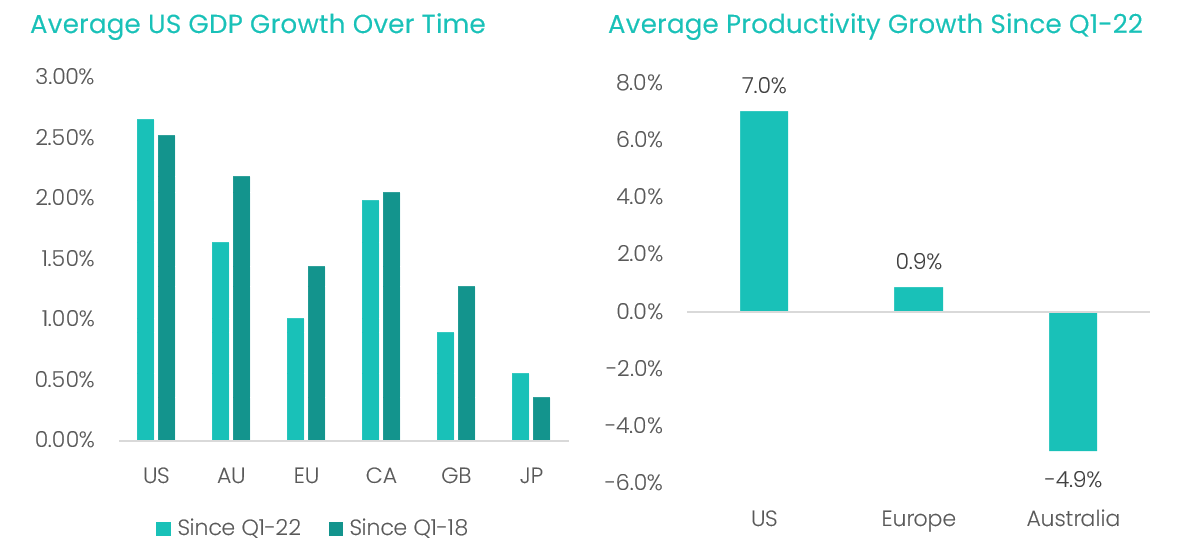
The U.S. continues to outperform most OECD peers on core macroeconomic measures. Recently released Q3-25 data shows annualised quarter-on-quarter GDP growth of 4.4% alongside a 4.9% surge in labour productivity - both the strongest readings since Q3 2023.
Since the beginning of 2022, U.S. labour productivity has risen by a cumulative 7.0%. Over the same period, Australia’s productivity has declined by 4.9%, while Europe’s has been broadly flat at just 0.9%. This productivity advantage - driven by the U.S.’s innovation-led business culture, more flexible labour markets and structurally lower energy costs - has translated into consistently stronger economic growth over time.
Source: Savana, S&P Global.
The United States remains the centre of global innovation and continues to outpace its peers in deploying capital toward the technologies most likely to drive the next wave of productivity and economic growth.
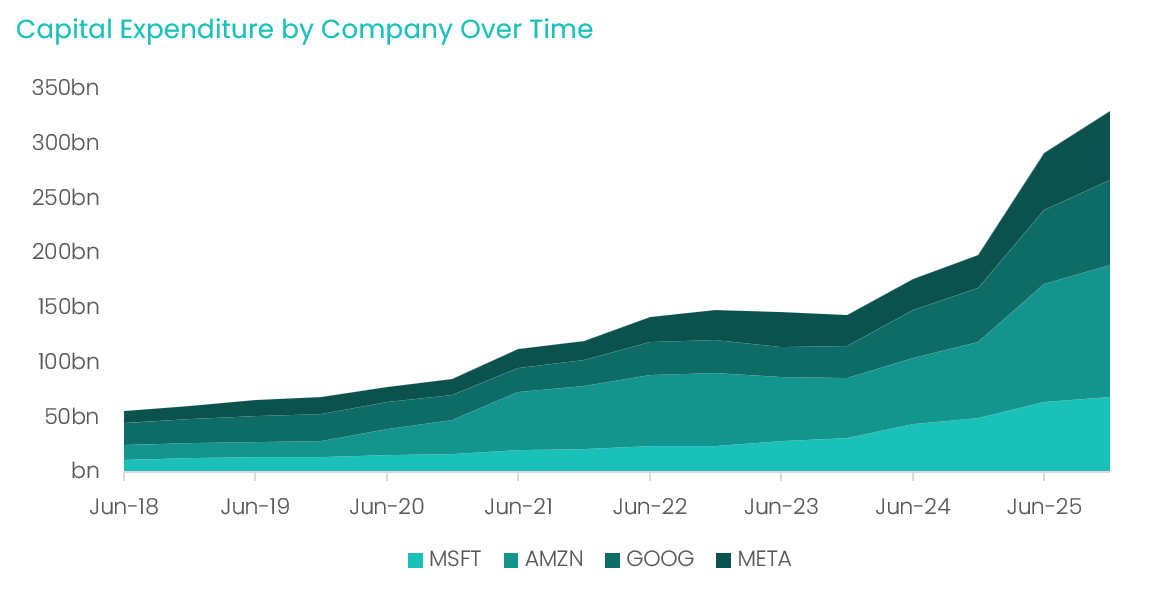
In 2025, U.S. technology leaders - Amazon, Microsoft, Alphabet and Meta - invested a combined A$329 billion in AI infrastructure and related capital expenditure, representing a 66% year-on-year increase. This surge in spending is not only expanding the U.S. economy’s long-term productivity frontier; it is also fuelling a broader upswing in activity across construction, utilities and advanced manufacturing.
According to S&P Global, data-centre and AI-related investment accounted for roughly 80% of U.S. private domestic-demand growth in the first half of 2025.
Source: Savana, S&P Global.
Amidst all the political theatre and gamesmanship, investors often lose sight of the fact that economic prosperity remains the single biggest priority in Trump’s political doctrine, which has culminated in one of the most investor-friendly climates amongst developed markets.
The One Big Beautiful Bill (OBBB) marked one of the largest deregulatory pushes in modern US history, stripping back red tape across high-multiplier sectors such as energy production and infrastructure. One of the most underappreciated features of the OBBB was the reinstatement of 100% bonus depreciation, allowing companies to deduct the entire cost of qualifying investments in the first year, materially lifting the net present value of new projects and incentivising earlier, larger-scale capital deployments. With an already low statutory corporate tax rate of 21%, many analysts argue that the broad range of deductions, credits and allowances facilitate an effective tax rate that is closer to 10%.
Combined with anticipated monetary policy easing and persistently elevated fiscal spending, these measures may form a ‘perfect storm’ for risk assets to accelerate in 2026.
As our local Australian market stares down the barrel of declining corporate profits, sticky inflation and the prospect of further rate rises, the US offers a powerful alternative as the world’s centre for growth and innovation.
With the Australian dollar sitting near three-year highs against the greenback, this may provide a favourable window for investors to gain exposure to the world’s most dynamic equity market.


In these Trumpian times, geopolitics has re-emerged as a central force shaping financial markets. That shift was laid bare in January as attention turned to the Davos Economic Forum, with gold and foreign-exchange markets swinging sharply amid deepening geopolitical fractures. US posturing over Greenland and growing unease about the independence of the Federal Reserve pushed gold to record highs above US$5,100 per ounce, while the dollar slid to a four-year low against a broad basket of currencies.
And yet, for anyone familiar with Trump’s negotiating playbook, the subsequent late-month reversal was scarcely surprising. In his Davos address, Trump defused speculation around military escalation and shortly thereafter flagged the emergence of a “framework” agreement. Then, in the final days of a turbulent month, he nominated Kevin Warsh - widely regarded as both well-credentialed and distinctly hawkish - as the next Federal Reserve chair, easing fears of political interference in monetary policy and helping to trigger the biggest single-day decline in gold since the 1980s.
The episode was emblematic of a broader pattern of five years of Trumpian rule: heightened political noise, but little lasting economic or financial damage.
For investors willing to look through the geopolitical malaise, we believe the United States remains by far the most compelling long-term investment destination.
Here are the three forces underpinning our bullish view on US equities today:
The U.S. continues to outperform most OECD peers on core macroeconomic measures. Recently released Q3-25 data shows annualised quarter-on-quarter GDP growth of 4.4% alongside a 4.9% surge in labour productivity - both the strongest readings since Q3 2023.
Since the beginning of 2022, U.S. labour productivity has risen by a cumulative 7.0%. Over the same period, Australia’s productivity has declined by 4.9%, while Europe’s has been broadly flat at just 0.9%. This productivity advantage - driven by the U.S.’s innovation-led business culture, more flexible labour markets and structurally lower energy costs - has translated into consistently stronger economic growth over time.

Source: Savana, S&P Global.
The United States remains the centre of global innovation and continues to outpace its peers in deploying capital toward the technologies most likely to drive the next wave of productivity and economic growth.
In 2025, U.S. technology leaders - Amazon, Microsoft, Alphabet and Meta - invested a combined A$329 billion in AI infrastructure and related capital expenditure, representing a 66% year-on-year increase. This surge in spending is not only expanding the U.S. economy’s long-term productivity frontier; it is also fuelling a broader upswing in activity across construction, utilities and advanced manufacturing.
According to S&P Global, data-centre and AI-related investment accounted for roughly 80% of U.S. private domestic-demand growth in the first half of 2025.

Source: Savana, S&P Global.
Amidst all the political theatre and gamesmanship, investors often lose sight of the fact that economic prosperity remains the single biggest priority in Trump’s political doctrine, which has culminated in one of the most investor-friendly climates amongst developed markets.
The One Big Beautiful Bill (OBBB) marked one of the largest deregulatory pushes in modern US history, stripping back red tape across high-multiplier sectors such as energy production and infrastructure. One of the most underappreciated features of the OBBB was the reinstatement of 100% bonus depreciation, allowing companies to deduct the entire cost of qualifying investments in the first year, materially lifting the net present value of new projects and incentivising earlier, larger-scale capital deployments. With an already low statutory corporate tax rate of 21%, many analysts argue that the broad range of deductions, credits and allowances facilitate an effective tax rate that is closer to 10%.
Combined with anticipated monetary policy easing and persistently elevated fiscal spending, these measures may form a ‘perfect storm’ for risk assets to accelerate in 2026.
As our local Australian market stares down the barrel of declining corporate profits, sticky inflation and the prospect of further rate rises, the US offers a powerful alternative as the world’s centre for growth and innovation.
With the Australian dollar sitting near three-year highs against the greenback, this may provide a favourable window for investors to gain exposure to the world’s most dynamic equity market.


In these Trumpian times, geopolitics has re-emerged as a central force shaping financial markets. That shift was laid bare in January as attention turned to the Davos Economic Forum, with gold and foreign-exchange markets swinging sharply amid deepening geopolitical fractures. US posturing over Greenland and growing unease about the independence of the Federal Reserve pushed gold to record highs above US$5,100 per ounce, while the dollar slid to a four-year low against a broad basket of currencies.
And yet, for anyone familiar with Trump’s negotiating playbook, the subsequent late-month reversal was scarcely surprising. In his Davos address, Trump defused speculation around military escalation and shortly thereafter flagged the emergence of a “framework” agreement. Then, in the final days of a turbulent month, he nominated Kevin Warsh - widely regarded as both well-credentialed and distinctly hawkish - as the next Federal Reserve chair, easing fears of political interference in monetary policy and helping to trigger the biggest single-day decline in gold since the 1980s.
The episode was emblematic of a broader pattern of five years of Trumpian rule: heightened political noise, but little lasting economic or financial damage.
For investors willing to look through the geopolitical malaise, we believe the United States remains by far the most compelling long-term investment destination.
Here are the three forces underpinning our bullish view on US equities today:
The U.S. continues to outperform most OECD peers on core macroeconomic measures. Recently released Q3-25 data shows annualised quarter-on-quarter GDP growth of 4.4% alongside a 4.9% surge in labour productivity - both the strongest readings since Q3 2023.
Since the beginning of 2022, U.S. labour productivity has risen by a cumulative 7.0%. Over the same period, Australia’s productivity has declined by 4.9%, while Europe’s has been broadly flat at just 0.9%. This productivity advantage - driven by the U.S.’s innovation-led business culture, more flexible labour markets and structurally lower energy costs - has translated into consistently stronger economic growth over time.

Source: Savana, S&P Global.
The United States remains the centre of global innovation and continues to outpace its peers in deploying capital toward the technologies most likely to drive the next wave of productivity and economic growth.
In 2025, U.S. technology leaders - Amazon, Microsoft, Alphabet and Meta - invested a combined A$329 billion in AI infrastructure and related capital expenditure, representing a 66% year-on-year increase. This surge in spending is not only expanding the U.S. economy’s long-term productivity frontier; it is also fuelling a broader upswing in activity across construction, utilities and advanced manufacturing.
According to S&P Global, data-centre and AI-related investment accounted for roughly 80% of U.S. private domestic-demand growth in the first half of 2025.

Source: Savana, S&P Global.
Amidst all the political theatre and gamesmanship, investors often lose sight of the fact that economic prosperity remains the single biggest priority in Trump’s political doctrine, which has culminated in one of the most investor-friendly climates amongst developed markets.
The One Big Beautiful Bill (OBBB) marked one of the largest deregulatory pushes in modern US history, stripping back red tape across high-multiplier sectors such as energy production and infrastructure. One of the most underappreciated features of the OBBB was the reinstatement of 100% bonus depreciation, allowing companies to deduct the entire cost of qualifying investments in the first year, materially lifting the net present value of new projects and incentivising earlier, larger-scale capital deployments. With an already low statutory corporate tax rate of 21%, many analysts argue that the broad range of deductions, credits and allowances facilitate an effective tax rate that is closer to 10%.
Combined with anticipated monetary policy easing and persistently elevated fiscal spending, these measures may form a ‘perfect storm’ for risk assets to accelerate in 2026.
As our local Australian market stares down the barrel of declining corporate profits, sticky inflation and the prospect of further rate rises, the US offers a powerful alternative as the world’s centre for growth and innovation.
With the Australian dollar sitting near three-year highs against the greenback, this may provide a favourable window for investors to gain exposure to the world’s most dynamic equity market.