
The art of catching falling knives
The market's firmest rule is never to catch a falling knife. It is also the reason its best bargains so often go unclaimed.
Every investor learns the same warning early: never try to catch a falling knife. When a share price is dropping hard, the safe course is to stand back, let it land, and buy only once the dust has settled and the uncertainty has cleared. It is sensible-sounding advice, and almost everyone follows it.
Howard Marks, the co-founder of Oaktree Capital, takes the opposite view. The refusal to catch a falling knife, he argues, is a rationalisation for inaction.
“It’s our job to catch falling knives. That’s how you get bargains. But you have to do it carefully.”
His point is simple. By the time the knife has landed and all the uncertainty is gone, the price has already rebounded, and the bargain with it. The discount and the discomfort arrive together, and you cannot have one without the other. Which raises an obvious question. If the richest bargains appear precisely while a price is still falling, why do so few investors ever reach for them?
A falling price is not a failing business
Part of the answer is that the adage quietly runs two different things together. One is a price that is falling. The other is a business that is deteriorating. They often travel together, but not always, and the gap between them is where the opportunity lives. A price can fall because a company is genuinely worth less, or it can fall simply because other people are afraid. Only the first is a reason not to buy.
Telling them apart is hard, because a falling price is persuasive. People extrapolate the recent decline, assume the trend continues, and sell into weakness to stop the pain. That collective flight pushes the price down faster than the facts warrant, and the stock overshoots well below what the business is worth. The knife falls further than it should, which is exactly what makes catching it worthwhile.
Why the knife stays on the floor
Knowing all this changes surprisingly little, because the harder barrier is not analytical. It is professional. For a fund manager, catching a falling knife is a career risk long before it is an investment risk.
Keynes described the mechanism ninety years ago: worldly wisdom, he wrote, teaches that it is better for reputation to fail conventionally than to succeed unconventionally. Buy a falling stock and watch it fall further, and you look reckless, and clients and employers remember it. Stand aside and miss the rebound, and you are in good company, because everyone else stood aside too. The incentives are asymmetric, and they point away from the bargain. For a career, the rational choice is to leave the knife where it lies, even when the odds of catching it favour the buyer.
So the discount survives. Not because no one can see it, but because seeing it and acting on it are two different things, and the second carries a cost that has nothing to do with the merits of the trade.
Where the bargains cluster
This has a familiar shape. A market is usually wise because it pools a large, diverse and independent set of views. A heavy sell-off is what happens when that breaks down. Fear makes everyone's judgement point the same way, the investors who disagree step aside rather than stand in front of the selling, and the price stops reflecting the balance of evidence and starts reflecting the mood. The crowd's wisdom gives way to its anxiety, and value and price come apart. The sharper the fall and the darker the sentiment, the wider that gap tends to be. Which is only to say that the falling knife and the genuine bargain are, more often than not, the same object seen through different eyes.
What a rules-based process can do that a person cannot
This is the problem a systematic process is suited to. It feels no fear when a price is falling, and it has no reputation to protect if the fall continues. So it can do the one thing the adage and the career both discourage: separate the price from the business, and act on the difference. It asks a narrow, unemotional question. Does the estimated value of the company sit meaningfully above the price the market is asking, whichever way the price is moving? When the answer is yes, it buys into the decline rather than waiting for the comfort that would erase the discount.
The companies that suit this approach are not simply cheap. They are sound businesses trading well below fair value, where the downside is already in the price and the upside is being overlooked. That asymmetry, more room to recover than to fall, is a margin of safety doing its work. And the same detachment that lets such a process buy also lets it sell, trimming a position once the gap has closed rather than letting a winner harden into an attachment. Discipline on the way in, and discipline on the way out.
The case in practice
This is the discipline Savana's systematic process is built to apply, and a recent case study shows it at work. Everforth, a provider of IT consulting and workforce solutions, had been sold down heavily through 2025 as weak demand, margin pressure and policy uncertainty drained sentiment. By early 2026 the shares had lost the better part of their value from their high, and then a single quarterly earnings miss sent them sharply lower again. To almost everyone watching, it was a textbook falling knife, and the textbook said leave it alone.
Savana's valuation told a different story. The selling had pushed the price well below what the underlying business could support: further weakness was already priced in, and any recovery was being given little credit. That is the asymmetric setup the process is built to find. So it bought, into the weakness, while the price was still falling and sentiment was at its worst. As the company's earnings steadied and fresh catalysts emerged, expectations shifted from terminal decline towards stabilisation, and the shares recovered strongly. The same rules that bought the position then pared it back as the discount closed.
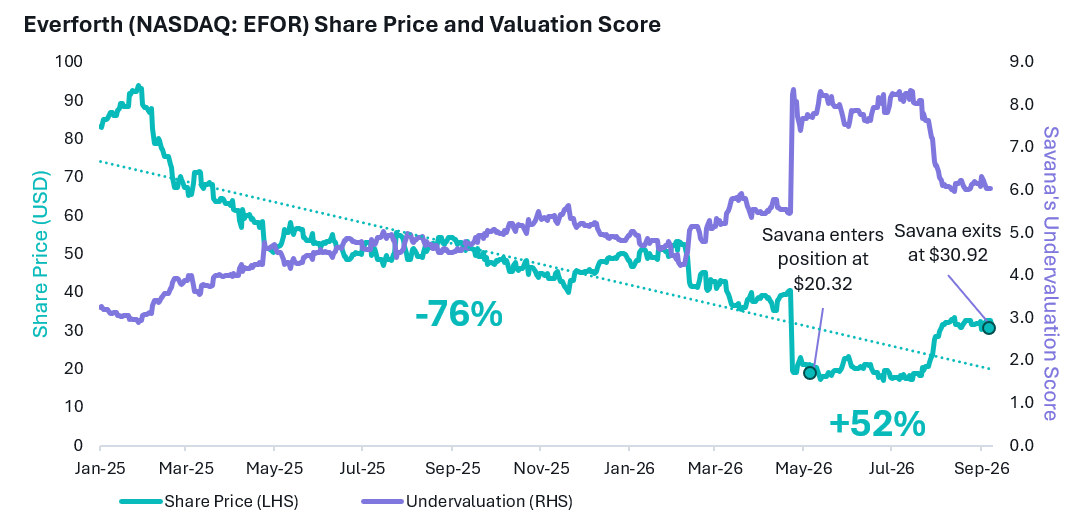
None of it required a forecast about the exact bottom, or the nerve to stand in front of a collapsing price. It required only a valuation the process trusted, and the absence of the fear that keeps others away.
The reckless part was refusing
A falling knife is dangerous for two reasons. You might misjudge the business behind it, and you might be judged for trying. Remove both, measure value without flinching and invest without a reputation to defend, and much of what looks like a knife to the rest of the market turns out to be a bargain that simply arrived at speed. Catching it was never the reckless part. Refusing to was.


This material is for information purposes only and has been prepared for both retail and wholesale investors. It is not an offer or a recommendation to invest. No representation is made as to future performance or volatility of the investment, and there is no guarantee that the investment objectives or strategy will be successful. Any forward-looking statements, opinions and estimates are based on assumptions and contingencies which are subject to change without notice. No representations or warranties, expressed or implied, are made as to the accuracy or completeness of the information contained in this document. In preparing this document, we have relied upon and assumed, without independent verification, the accuracy and completeness of all information available to Savana. Persons should rely solely upon their own investigations in respect of the subject matter discussed. To the maximum extent permitted by law, all liability in reliance on this document is expressly disclaimed.
This material may not be reproduced, distributed or published, in whole or in part, without the prior approval of Savana. There are risks associated with an investment in the Savana US Small Caps Active ETF (SVNP), including active management risk, market risk, currency risk, concentration risk, liquidity risk and model risk. Investment values may rise and fall, and past performance is not indicative of future performance. This material has not been prepared taking into account your objectives, financial situation or needs. An investment in SVNP should be considered as part of a broader portfolio, having regard to your individual objectives, financial situation and needs, including your tolerance for risk. Before making an investment decision, you should consider the Product Disclosure Statement (PDS) and Target Market Determination (TMD), available at www.savana.ai.
More from Insights


Subscribe for Monthly Updates